

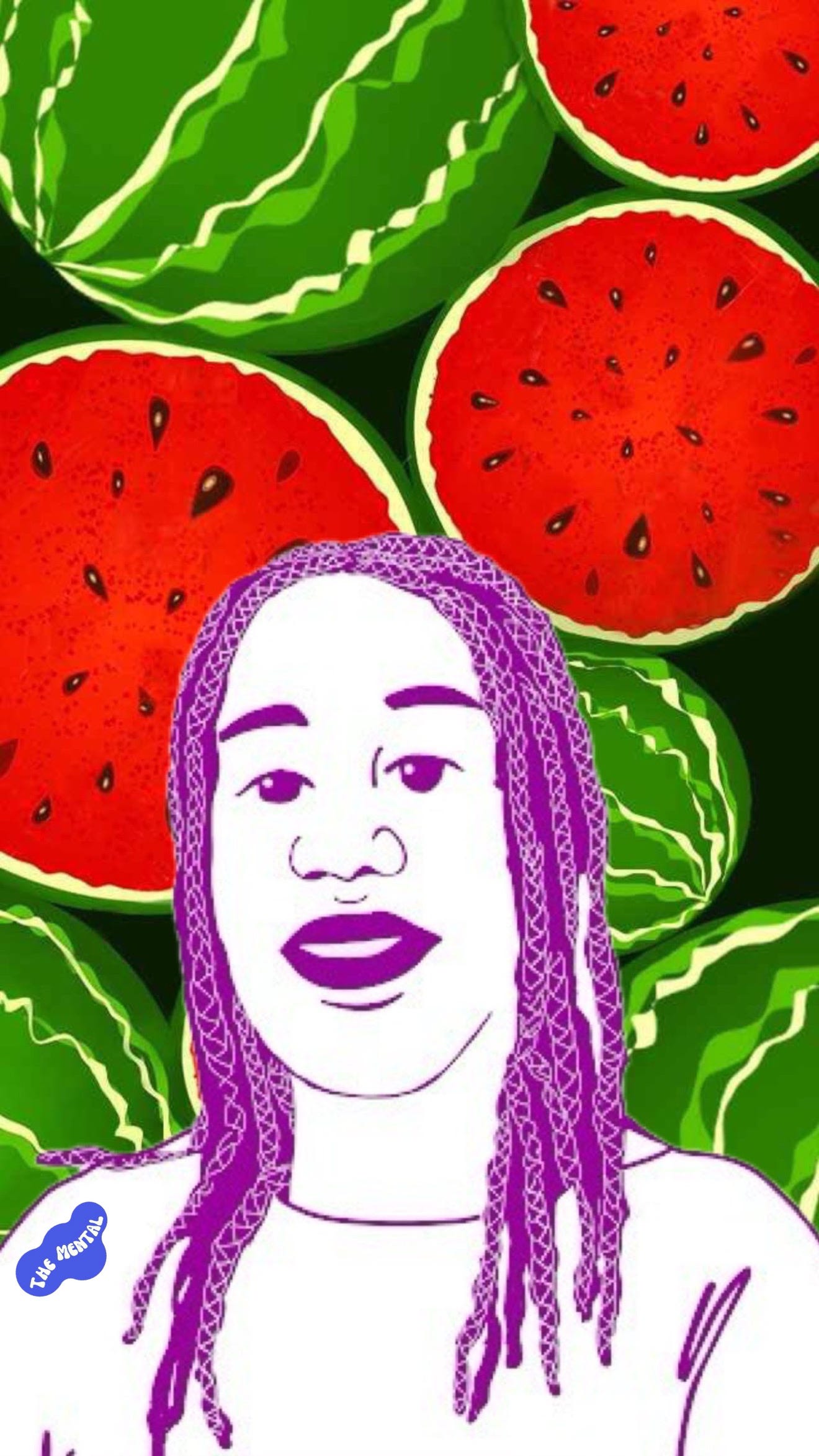
Today’s edition of The Mental features my dear friend Azza (she/her), visiting New York from Europe, by way of Egypt and formerly Sudan. Azza is one of those special people that brighten up any room with her warm energy, infectious smile, and sheer brilliance. Azza is full to the brim with stories that will make you laugh and cry in equal measure. She has dedicated her life to the pursuit of gender equality, queer and trans rights, digital rights, safety and security, and human rights more broadly in the SWANA region and worldwide. All this to say, she is a big inspiration to me.
Azza and I met at a work conference in 2024, and instantly connected. It was an energy thing, and dare I say, a bipolar thing. I saw her, and she saw me. We immediately got lunch together and vented and lamented all about the woes and the cognitive dissonance and the evil fucked up bullshit of the world. I felt so held in that conversation with her, despite having just met earlier that day. I knew instantly that she was someone special and that we needed to be in each other’s lives. I was thrilled to hear that Azza was coming to visit NYC, and so we got lunch and then spontaneously made our way to a SWANA party at Riis Beach, then made this interview happen on her drive up the coast a few days later.
I know that people are going to get a lot out of this interview, in the way that I did through witnessing it. I’m excited for you to read it! Thank you endlessly, Azza.
–
Content warning: Depression, bipolar, suicidality, conversion therapy
Ly: What does mental health mean to you?
Azza: Personally when I think of mental health, it’s not the absence of issues or problems but my ability to deal with them in a good and healthy way. And more balance means I’m not consuming a lot of my energy to deal with my mental health issues, the same amount of energy that I would use to get out of bed and do daily tasks - the same to any obstacles in my daily life.
Ly: Have you always had that perspective?
Azza: I’ve learnt it down the road. Growing up in environments where mental health is a taboo and always equated with being crazy, it wasn’t easy for me to have a relationship with the term mental health. It’s been scary, but I came to find out that it’s part of my life and personality and there’s nothing wrong with it–and sometimes a sign of creativity and uniqueness, so I embrace that.
I also come from a conservative culture where the idea of being queer or slightly different in any way–how you talk, walk, the food you like, the music you love–is hard. If you are not following the majority or if you are an outsider, it causes a lot of issues and anxiety because you’re under focus all the time.
So when I started to actually have different feelings for people of the same gender, I figured out that it was something which was going to make me an outsider, so I started reading about it. Most of the writings about homosexuality in Arabic were very homophobic and talked about the issue from a religious and cultural perspective: sin, out of the norm, out of nature.
So in my mind I thought “I have a problem, and I have to deal with it,” so at 14 years old I went to a therapist saying “I have a problem and I need you to help me.” I couldn’t articulate it at the time, that sometimes I feel different feelings, but they walked me through different things where I found out about myself as a homosexual. So I learnt about it as being mentally ill.
I never stayed with one therapist more than 4 - 5 months because I was never “cured,” so I saw them as not good. When I was a little bit older when I was 17 or 18, I came up with the brilliant idea that maybe therapy alone is not enough; that I have to see a psychiatrist to add the medical element to therapy. I went to a psychotherapist and he promised me, showed me cases of people being cured from their “disease of homosexuality.”
From the first session he prescribed me medication which I didn’t know at the time were antidepressants, but I didn’t mind because I just saw it as something to cure me from my “weirdness” as I called it.
I would see a therapist to follow up from the medication, which would make me numb like a walking dead zombie–so it did stop me from feelings, but not related to my homosexuality.
I became like an emotionless person, getting out of bed and doing the things I needed to do, but sometimes I stopped taking them, and this was continuous for 4 - 5 years where I was in and out.
I didn’t know at the time, but later I was diagnosed with bipolar. I wasn’t familiar with it, I didn’t know what it was, but I learnt that it’s a type of condition or state of mind where you can have different episodes of being depressed and manic–but I wasn’t aware, and the antidepressants kicked in the mania side.
At that time I just thought I was productive, people would say “how many hours do you have?” “Do you sleep?” I literally did things that 3 normal people would normally be able to do.
So at one part of my life when things should go easy, I was in political activism, human rights–mainstream women’s rights, etc, and I joined a Tariqa–a Sufi path. It was my spiritual practice and my way of getting away from the crowded social atmosphere. I was heavily involved, though most of the people who do this practice are people who are older, not younger generations; I was very devoted.
I would wake up at 4am to go to the mosque, my family was very worried about me–and more, at the same time I was playing sports. I used to go downtown in Khartoum City, while we used to live in a suburb, so it would take me 3 kinds of transportation to go and practice.
Up to now, I don’t know how I mixed all these things together.
I think I also didn’t want another level of anxiety where my social networks were mixed, so I would make sure the people I knew in sports circles didn’t know the same people I did human rights activism with or in my sufi circles. Every time I was emotionally or socially drained, I’d jump between these circles–I think it was my coping mechanism.
They were very productive years of my life but I realise it was because of my medication that pushed beyond my human abilities–I was exhausted all the time, only sleeping 4 - 5 hours a day. And this was happening for 4 - 5 years.
When you don’t want people to know or be worried about you, you just shift between circles.
It’s also one of my coping mechanisms, when I wasn’t eating a lot, but I was making sure that I’d given time to having food–even though I was in this fast paced life, running between different places, I dealt with meal time as taking time to relax, test it, feel it, see if you like it.
It was the only thing that kept me from running in circles, so I developed the habit of eating all the time.
Shit happens, in theory I always knew that, but I finally genuinely started being relaxed about it when I met my partner, who also had experiences of different issues, and they were very cool about it. Not in terms of it’s not hard or painful, or that they didn’t struggle–they did–but they had reached a point where they looked at it from a different perspective: people with beautiful brains–we just function in a different way.
My partner walked me through the process, and how to look at the issue from an outside perspective–before it was just me, me, me, having this issue and this struggle. But then suddenly I had this bird’s eye view to go outside of myself to say sometimes I feel like I’m struggling, but actually I am a beautiful person who is doing great things and I shouldn’t undermine that by stressing on the anxiety and mood swings all the time.
I tried to look at it as being really good with working with communities, and people sarcastically would say I should be a therapist because I’m a good listener, I’m good with people, and good with energies, and I think from my experience I feel people’s energy, and that gives me the gift of being able to help others in that way.
Ly: In my experience, those who I know are bipolar seem to be very compassionate, empathetic and good energy readers too! How did this relate to your spiritual practice?
Azza: I think my spiritual practices helped in a way, but I was not conscious about it. I had 6 years of sufi practice, going to the mosque, being dedicated to this group, different events, and somehow it changed my energy–and I wasn’t aware of what I was doing at that time, at the time it seemed a very traditional thing growing up in Sudan, we used to say that if any household has no one in the family who is Sufi, then it’s not an authentic Sudanese household. I don’t believe that, but people were saying that. Somehow the practice without me being aware, helped me reduce anxiety and mood swings, and even with the mania, as there was lots of dancing and singing and enchanting–this was a chance for me to use my physical energy, so by the time I came out of the enchanting circles, I didn’t have the energy to do anything else.
I left the country, but I didn’t leave the practice. When I travelled I expanded my spiritual practices and tried to move away from religious practices–which was the only thing I knew–then expanded to different philosophical practices and different mystical practices etc, so I finally understood the science behind how you rewire your brain when you do different mantras or mudras, or different exercises to open your chakras, etc. One of the things I do every morning is qigong practice, which helps regulate my nervous system and also my energy when I start my day. All these things helped but earlier I wasn’t aware of it, I didn’t see how it affected my mind and my body, but it helped a lot.
I had a really hard time around 2010. I was at the peak of my anxiety, I was living with my family, and had all these issues where I had started to feel more comfortable with my sexuality but had to hide it living with my parents–it was really hard.
And so I decided to leave the country and left my family and life behind, and the medication behind too. It was 2010, I didn’t have a plan in the beginning, but I told myself I would find a way without the medication, regulating my mood through exercise, diet, herbs and other stuff. Then I was very relaxed and open about it–I didn’t mind talking about it, saying “hi, my name is Azza, and I have bipolar etc.” Now I feel like there is no need, especially at work, or if I’m not very close to someone, then I feel there is no need, but it’s not out of shame or anything like that.
One thing I’ve recently started to have–I always tell my friends I have a very strong gaydar so I can sense the queerness in people, but I recently developed this radar where I can feel energies around me where I know when people are carrying mental health packages–I see people like the colorful chairs here in this room, I can sense which mental illness people in the room are struggling in and I see it in different colors. I think the experience of the pandemic during the lockdown intensified my feelings–how I get into other energies, how I feel other people around me–it’s a gift.
I was diagnosed with bipolar a long time ago, but recently I was working with a therapist and she said she didn’t think I was bipolar. I felt offended, like she was taking something away from me. She was leaning more to ADHD or ADD–she wanted me to go have all the tests, but I didn’t–maybe my insurance didn’t cover it. But she was very convinced I didn’t have bipolar, because I don’t have many episodes anymore, but I have become very good at regulating my moods, and only an episode sometimes not even for 2 years.
The common things I usually do that are easy for me to do without much effort is driving, or being in motion–like taking a bus and going somewhere randomly in another city for 1-2 hours and then coming back, or I drive my own car, but that’s the common theme for me.
I spend money on things, I go buy things that I need, this or that, not thinking about how much money I have to spend. I could go sit in a bar or a cafe and talk to a stranger then buy them drinks and be happy etc, but the most interesting thing that I do when I’m in a manic period is I write.
My creativity comes out in a very crazy and very exhausting way. Or I read 3 books literally at the same time, I don’t do the drawing thing anymore - I don’t feel like it’s the first thing I’d do creatively anymore, but before I wanted to draw things and do artistic projects etc. Now I want to be out, drive, write or read. Usually I am a TV person, watching movies or something, but manic I become agitated and I cannot sit down.
Unfortunately, much of the writing projects I start in a manic episode usually don’t last long - like 2 days–I get blocked after that. Usually I’m very excited about a topic–I do fictional writing and see all the characters all in my mind like I’m watching a movie, but after those 2 days I’m not connected to these characters and I don’t know what they’re doing in their life. So I just leave that alone–but that’s painful, as my writing is always associated with being in this situation. I feel like it’s not a gift that I have, but this person who is in this state of mind–like I am not that person but another person.
One good thing that I really want to mention, though having bipolar is not an easy thing–I don’t want to romanticise it, whether you are in a depression state or manic state–but somehow it’s helped me with my activism. Roughly I started my activism in 2007, I had a blog and was working on a project of writing queer short stories and poems in Arabic for queer women. I think the mania helped me because it was when I was on the antidepressants–so it was associated with that. For most people when they have mood swings, it hinders their ability to do activism in a good and useful way, but somehow this helped me to keep things steady. From the people who started doing activism in 2010, there are a handful of people who are still there, having been continuously non-stop since 2010 until now, and you are one of them.
When I look back I was involved in so many things–even when I’m done with a project I feel like this is the thing I want to do. I feel sometimes my mood swings play a role in that, keeping alert in working for the community and in having a purpose–when I go down and up, more often up, there’s a purpose and I have to use my energy on it. I have to think about this being hyper etc, as the universe motivating me to do my activism. Even when you’re depressed, you feel like people are depending on you, they’re out there, and it motivates you to come out of the depression very fast.
When I was in Sudan I wasn’t involved in queer activism until I moved out, and at the time my political and human rights mainstream work stopped because I left the country so I had more time to think about my physical and mental health, and what I wanted to do. It was an identity crisis–in moving to the US I came with my family, so the mission was relocating, everyone to get to school or get a job, like the idea we are “upgrading our life” in moving.
The bipolar didn’t help because I ended up taking lots of classes and my school counselor was like are you sure? Here people take 3 classes, but at home, on average people take 7 classes and it’s normal. So I took many classes. I struggled because english is not my native language, and I had a side job, so many things were very overwhelming.
And there’s the story I told you about having my first girlfriend in Sudan. Within 1 year I left the country, and when I came back and we broke up, I had a very intense nervous breakdown. After that I was very focused on understanding my sexuality and how to deal with it, and how to accept it, so most of my time was not dedicated to my activism. So 2003 - 2010–these 7 years, in 2007 specifically, I accidentally, well in 2005, I stumbled into this queer muslim group operating here in the USA called Al-Fatiha–I stumbled upon this group online, with lots of Arabic speaking muslims etc. This was a discussion forum so I started speaking to people. After 3 months they invited me to the convening they do every year–at the beginning I was very afraid to go; what if I go and there are people I know? I was anxious. It was a 3 day conference, and people came from different places mostly in the US.
But this was a game changer for me. Because of my Sufi practice, I was kind of a religious person, so I wanted to mix my faith with my sexuality. Because it was seen as a sin–the religious part, made me feel anxious which made me do crazy things like conversion therapy, where I thought that if I do very hard sexual discipline practices, e.g., no masturbation, no porn, etc., that if I push myself into this direction, maybe I could get rid of these desires. During this 3 day event, I met nice queer people who were very comfortable about their sexuality and faith etc–the first time I met Imam Muhsin Hendricks, he really helped me a lot to be relaxed about my sexuality and accept things.
After I came back from this trip, the only thing in my mind was that I have to hang out more with queer people. I started volunteering–events like cooking and distributing food for queer people in the city. I became very socially active, and seeing that there are a lot of things in the USA, thought maybe I should devote my time and energy to help people back home. I kept this idea for a few years until I was done with school, then I had my first professional job in a big company. The job helped me to save money, knowing I have to work X amount of time, then vacation time and so on.
I started doing trips first to Sudan, then to Egypt and started talking to people in the community there, and at that time was blogging and making friends in the SWANA region, and because Egypt was a very touristic country, we would make plans for everyone meeting in Egypt during the summer time. So I met queer people from Lebanon, Jordan, Lebanon, Algeria, Sudan etc–I felt like this is where I was to devote my energy. In 2010, this is when I started devoting to queer activism. Everyone thought this was crazy, leaving a stable job, leaving the USA for Egypt–my family was freaking out. The 4 months before leaving permanently to Egypt all my mental issues would come out as physical issues.
My doctor couldn’t figure out what was wrong with me: migraine attacks, up until now bleeding heavily for no reason, I was given all kinds of medication. Nothing helped, I had multiple types of tests yet at some point I felt that the mental toll is attacking my body, so I need to do something about it. I thought that if I figured out my situation, that maybe if I did activism it would help me with my mood swings, etc. I stopped my medication at the time, and took a leap of faith. At the time, my family thought I was tired and just going to go for a few months and come back, so my mum flew to Egypt and said “you’re coming back with me.” I said no.
I have a very close friend and neighbour–she came with my mum–she did a great job, I can’t thank her enough–to say look at Azza, look how well she’s doing, she’s happy, her body is restoring, her mental and physical health back–my mum was eventually convinced so she left me. The journey from there started.
I started talking to some activists saying let’s do something. I used to date someone in Egypt on and off, and by the time I came to Egypt, I ended it as I felt it wasn’t good for me, then I met my ex. She was also Sudanese and we started talking online, then she moved to Egypt and we started dating. Things started to flourish–we started an organisation, and my partner wanted to be part of it; everything was in harmony.
I made the decision to stop the medication, so I saw a doctor to withdraw the medication gradually but within 4 - 5 months I stopped the medication–I didn’t need to regulate this way, I found my community–I found peace.
Living with my parents, I was always living under the pressure that my mum, my family is a little more progressive than the average Sudanese family but still conservative one way or another. When I moved to Egypt I was finally free, and we found a community and we’d go out and we’d eat and it was just a happy life.
There is nothing wrong with being queer or trans, it’s the community.
Whatever I was doing, I wasn’t sure, using herbs, or exercise, or diets, or spiritual practice. The biggest part was I had an alternative family–we grew the movement together and this had a big impact.
I had to leave Egypt due to the lack of safety. I was really sad because I loved my life there and I built something I could call home, but when this safety and security issue arose around the end of 2017, a lot of friends, circles, activists, all had to leave the country. I thought maybe it’s not an issue for me, as I had a very low profile so to some extent I was more protected than others, but when everyone else left, I had to make the decision to leave. Then I got this job which seemed like a good offer. So I took the decision and I left–which I think helped. In the first 6 months I felt the energy of the city I moved to, but I felt that my body couldn’t adjust. I came up with an idea for my boss that I want to do a tour of the region because I felt the energy was very heavy, but I struggled because I was dealing with the fact I lost my home, my people, I wasn’t sure what I was doing here, I felt like the kind of activism I was doing was only helpful to me.
But at this time I relapsed and I started to have lots of episodes, and I thought I don’t want to go back, and then when the pandemic hit it became very hard for me, so I went back to taking medication for a few months until stabilised. I felt that everything is crazy and my life is going upside down. I took time off from work and I joined this group therapy programme. It was very intense–from 10am - 1pm, 4 days a week we did different exercises–I did this from May to August 2020 and that helped, but by the end of the programme, I cut the medications again.
I’ve been doing great since, and I don’t have the mood swings as much as before, but I did develop clinical anxiety after that time, so it added another layer to the bipolar, and then the therapist was saying maybe I don’t have bipolar, so we started to explore other kinds of issues.
Ly: I’m so glad to hear you’ve been doing well since. I have a final question for you: what would you tell your younger self?
I wouldn’t focus too much on the issue of researching, talking and trying to figure things out–things will unfold and you will understand while you’re living your life. It’s a process, while you’re understanding yourself, you’re understanding your mental health, and your unique needs and also. It’s not something linear that the older you get or the longer you have the mental health issue the more you have expertise–it doesn’t work like that.
Everybody is different, you can share stories etc., but you’re unique, your body and mind is different, it’s not necessary that you will go through the same thing–some people cling to things aka what another bipolar person has gone through, it’s not guaranteed that you definitely will too.
Talk to other people around you about your needs because people don’t understand them like you do, and don’t wait until you’re in a situation of depression or mania. Do it when you are in a peaceful moment, tell people around you, especially your loved ones, have your safe words.
Sometimes I just want to tell people I am ok, I don’t need you to do something, but I am going through something, I don’t have the energy, but I am safe. Safe words or safe codes with friends and lovers are very helpful–one is strawberry. If someone says they want to hang out, I send them a strawberry emoji, that I am safe, but that I do not need anything but I am ok.
So think of a structure that works that is good for your friends, family members, and your lovers etc - and come to do it when you are not in a crisis - it’s important when you’re not in an episode.
Ly: Thank so much, Azza, for chatting with me today. I learnt so much from you, and I am so grateful to know you, and to know someone as wise and generous as you exists in the world!
💌
For more, please don’t forget to subscribe and follow @The_Mental_Zine on IG!
Please note that The Mental does not replace any form of professional healthcare, but simple hosts conversations to destigmatise the topic of mental health & mental illness. If you are struggling right now, please know that you are not alone. Please seek support from a medical professional.
If your situation is urgent (and keep in mind, you do not have to be at the rockiest of bottoms to seek help!), please find below a (non-comprehensive) list of suicide and mental health helplines from countries around the world - if your country is not listed, you can google search to find one in your area. These helplines are intended to provide critical, immediate assistance for anyone who may be struggling or needs someone to talk to. If you or someone you know needs help, don’t hesitate to reach out to one of these services for confidential support. If you have more to add, please add a comment to this article and we will update this list.
Global Crisis Text Line:
Crisis Text Line (Global, including the US, UK, Canada, etc.): Text HOME to 741741 (24/7, free and confidential support)
United States:
National Suicide Prevention Lifeline: 988 (24/7, free and confidential support)
Crisis Text Line: Text HOME to 741741 (24/7, free and confidential text support)
United Kingdom:
Samaritans: 116 123 (24/7, free and confidential support)
Text SHOUT: Text SHOUT to 85258 (24/7, free and confidential support)
Australia:
Lifeline Australia: 13 11 14 (24/7, free and confidential support)
Beyond Blue: 1300 22 4636 (24/7, mental health support)
Canada:
Crisis Services Canada: 1-833-456-4566 (24/7, free and confidential support)
Kids Help Phone: 1-800-668-6868 (24/7, confidential support for young people)
India:
Snehi: 91-22-2772 6771 / 91-22-2772 6773 (10:00 AM - 10:00 PM IST, emotional support)
Vandrevala Foundation: 9152987821 (24/7, mental health support)
New Zealand:
Lifeline New Zealand: 0800 543 354 (24/7, confidential support)
Youthline: 0800 376 633 (Available for young people 24/7)
South Africa:
Suicide Crisis Helpline: 0800 567 567 (24/7, confidential support)
Lifeline South Africa: 011 242 1911 (9 AM - 9 PM, emotional support)
Germany:
Telefonseelsorge (German Suicide Prevention): 0800 111 0111 or 0800 111 0222 (24/7, confidential support)
France:
Samaritans (SOS Suicide): 01 45 39 40 00 (24/7, confidential support)
Brazil:
CVV - Centro de Valorização da Vida: 188 (24/7, confidential support)
Mexico:
Línea Nacional contra el Suicidio: 800-911-2000 (24/7, free and confidential support)
Japan:
TELL Lifeline: 03-5774-0992 (9:00 AM - 11:00 PM JST, English-speaking service)
Argentina:
Línea Nacional de Prevención del Suicidio: 135 (24/7, confidential support)
Spain:
Teléfono contra el suicidio: 717 003 717 (24/7, confidential support)
Singapore:
Samaritans of Singapore (SOS): 1800-221-4444 (24/7, confidential support)
Pakistan:
AAS: 021-111-22-22-57 (10:00 AM - 10:00 PM PST, emotional support)