

Today’s interview is with the incredible Ayanna (she/her). Ayanna is a glorious human being, who is so goddamn talented it makes the rest of us want to step it up - in the best way! All this to say, she inspires me. Ayanna is an incredible fashion designer (hello prints!), artist and illustrator who hosts art tours in museums and galleries around the city of New York - be sure to check out her art here! I am proud to say I am the owner of not just one piece of her colorful artwork, but three (causal brag), which are hanging up pride of place in my apartment, all of which I obtained when she so kindly donated the profits of them to a fundraiser I was hosting for Palestine and Lebanon last year.
Ayanna and I also recently hosted a figure drawing event as a fundraiser for Palestine and for trans rights, and I can constantly inspired by her creativity, open-heartedness and authenticity. Whether we’re chatting about our weird and loveable cats, polyamory, her incredible colorful boob shirt (see photo below!) or a next exciting project, I always love spending time with Ayanna. As a fellow mixed race queer person, I instantly felt so much comfort in sharing my inner most thoughts with her, and I’m so grateful that in typically Ayanna style, she immediately jumped on the opportunity to be interviewed for The Mental! So, without further ado, please enjoy the interview below!
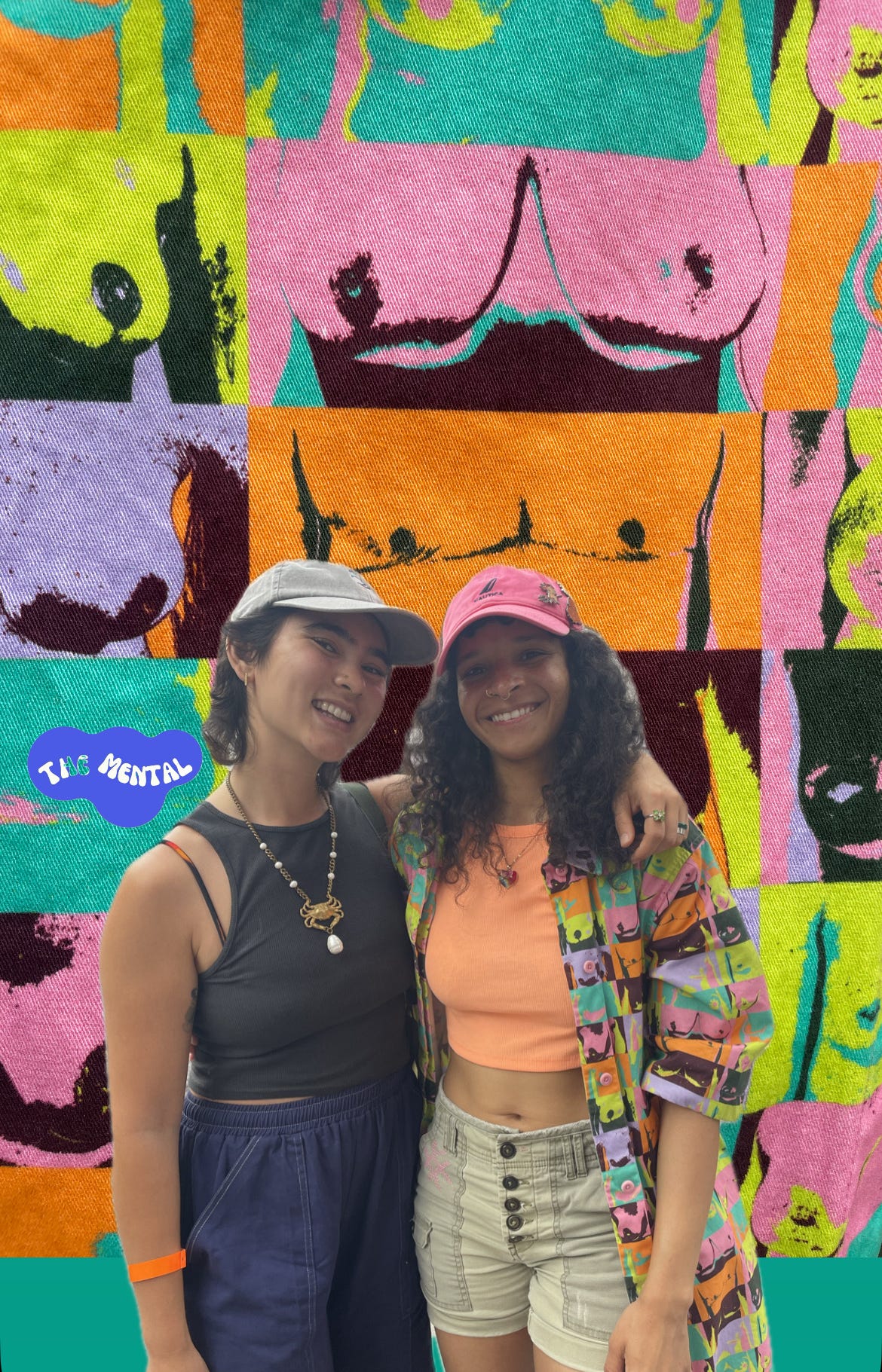
-
Content warning: discussion of addiction, alcoholism, suicide, grief, bereavement
Ly: What is your experience of mental health & mental illness?
Ayanna: Mental health is one of those areas, like a lot of my generation, I feel far less shame in discussing it than I have in the past. I’ve experienced fluctuation in my mental wellness from since I can remember to the present day. I’m neurodivergent and, as a young child, I had turbulence in my emotional regulation and I would sometimes have meltdowns and night terrors. My wellbeing was generally stable during adolescence, however I had a mentally ill parent and in my teenage years I experienced family trauma that would impact my mental health for the rest of my life. I’ve always had many friends, loving family, and a wide support network that have kept me stable in trying times and I couldn’t be more thankful to have them.
My maternal family has a unique history of mental illness ranging from PTSD, bipolar disorder, schizophrenia, depression, and substance use disorder. Growing up, my mother had post-partum depression and developed alcoholism as a result of her own prior trauma. She eventually succumbed to her disorder and passed away when I was 13. Similarly my cousin Dan, her nephew, developed an alcohol use disorder as well and committed suicide at the beginning of COVID. Substance abuse and addiction does run in my family so I keep that fact in the back of my mind whenever my mental health is in flux, I don’t want to ever get to the point where I use alcohol or drugs to mask my mental illness.
Today I feel overall optimistic and even-keeled in my mental wellness, though I’d be lying if I said I didn’t have downswings of anxiety, stress, and depression at times (occasionally due to my contraception.) I see a therapist once a month and regularly reflect on my mental/spiritual health journey and attachment style. I’m far from perfect, but I’ve grown to treat myself with more compassion for lapses in my emotional wellbeing. Our mental state, just like any other bodily system, can naturally go through well and unwell periods, and I try to remember that when I’m in a rough patch. I’ve learned in speaking up about my own struggles how similar our mental circumstances can be versus different. I feel the greatest contrast is in how we treat the emotions we feel and how we regard ourselves for feeling them.
Ly: What context do you live in? What is the understanding of mental health & mental illness in your culture? Can you be open?
Ayanna: Being raised by two American families (albeit from two different cultures as I am biracial), my cultural framework for understanding mental health is inherently northeastern American and from the perspective of a queer woman of color. My parents are open about mental illness and addiction as it relates to our family, in the ways they know how and with the tools and vocabulary they have at their disposal. Historically, both generational sides of my cultural makeup used artistic expression as an alternative when these open discussions weren’t possible yet, from the Mississippi Delta Blues to German Expressionism.
I’m happy to say I can be far more open about my mental health in my culture than I could previously. I think we’ve experienced enough of the consequences of shame in discussing mental health that my immediate family creates a safe space for me to be open with how I’m managing mentally and emotionally. Having candid conversations on the topic has been challenging, especially within the context of a black American family from the deep south, but it’s absolutely a necessary reparation. There’s still so much room for growth, but I’m excited to see that conversation shifting in my generation forward and humans being more open and understanding of the subject.
Ly: How does the stigma impact you? How do you feel about diagnoses?
Ayanna: Across the world, but speaking especially regarding Americans, there’s a stigma and general misconception for everything I’m diagnosed with. Let me start off by saying I am in favor of diagnoses and making evaluations more accessible as a form of healthcare. Diagnoses are life-saving, course-altering care and I feel so fortunate that I’ve gained that knowledge and help I’ve needed.
I have ADHD (attention-deficit/hyperactive disorder), ASD (Autism Spectrum Disorder) and PTSD (post-traumatic stress disorder). Upon my pre-school teacher’s suggestion I was evaluated for and diagnosed with ASD when I was 3, something very rare for girls and AFAB children in the nineties. In my 20s I arranged my own evaluation for ADHD and was diagnosed with an attentive-hyperactive combination last year. My life has vastly improved after starting medication for it.
Stigma really takes away my individuality and promotes harmful stereotypes ascribed to people like me. Most I’ve spoken to have pre-conceived notions that being autistic means you misread all social cues, have an affinity with trains, lack empathy, are violent, lack intelligence, are genius savants or all of the above, even after I’ve told them I have ASD. I feel people really struggle with understanding that ASD is referred to as a “spectrum” for a reason and the fact that autism presents in such a variety of ways we’re just learning to recognize now.
Our criteria for diagnosing ASD, ADHD, and so many other afflictions is based on white male children and how they present. Women, AFAB folks, and people of color are gradually being included in these studies and diagnoses although we still have a long way to go in understanding autism. I heard someone say once that being autistic is like being a different computer model, a “Mac in a PC world” so to speak. Some humans are better suited for Adobe Creative Suite, while others lend themselves more to hardware customization and gaming. That analogy has stuck with me ever since.
My feelings on self-diagnoses are complicated as I feel self-directed research can be a great jumping point for getting a formal diagnosis (it absolutely was in my case), but with a healthy amount of skepticism as well. I’ve seen enough instances where people miss the mark and further push false beliefs about conditions at best, and at worst give those that will more license to weaponize conditions they may or may not have. Many mental illnesses also share overlapping traits like anxiety, depression, burnout, and emotional dysregulation, so I’m sure it’s incredibly challenging for the untrained to properly assess. I personally feel that a professional evaluation is ideal for diagnoses and treatment, though I understand that these are costly and a privilege many don’t have access to in America.
Ly: What do you wish you’d known earlier/what would you tell your younger self struggling?
Ayanna: Haha well, I wish I would’ve known I had ADHD at a younger age. That would’ve answered a lot of questions I had, and greatly improved my focus in high school and during my undergrad degree. But in all seriousness I’d give my younger self the advice of “if it feels bad to you, then it is.” I feel like I spent time around friends and in some toxic dynamics that didn’t feel right at the time, but since we had a history I was a lot more forgiving than I probably should’ve been. I feel like friendships have a lot more impact on our mental health in youth and adulthood than we initially realize, so I make more of a point to ask myself if the people I spend the most time with are uplifting or depleting my energy.
I’d also tell my younger self that my situation is not unique, and that it will get better. It may not feel like it at the moment, but I can always grow and reach new heights of well-being as long as I’m still breathing and trust my own timing. Whether you’re at rock bottom or on your way to it, you can always go up from there.
Ly: How is this different from what you’d tell someone else in the future?
Ayanna: All of the above isn’t too different from what I’d tell someone else with similar struggles to me, though I’d come from a place of investigation rather than decisive wisdom. We all have such individual pain points and I’ll never make the claim that because something worked for my wellness, that the same will automatically work for someone else. I’d cater my advice to suit their needs, and of course not give it unsolicited either.
I’d also strongly encourage others to explore therapy that works for them, whether that’s cognitive/dialectical therapy, brunch with friends, screaming off a cliff, spiritual gatherings, meditation or yoga. I’ve been in and out of talk therapy since I was 11 years old and while not all therapists have been a match for me, I’m grateful for them all the same. Lately meditation and yoga have been helping me center myself and my mental health as of late.
Ly: What has helped you on your mental health journey?
Ayanna: Creative expression through the arts has been incredibly healing in my life and has shaped how I manage my emotions. Integrating my own neurodivergence into my work has also felt very liberating, understanding that my brain works the exact way it’s supposed to, and both its unique skills and challenges help me create outside the box.
Foremost a visual artist/writer, I’m heavily inspired by macabre subject matter and both the joys and horrors of the human condition. So many horror films and stories are about internal conflict, prejudice, and isolation and I find these narratives speak to me most. Learning about the darkness of others helps me to better understand my own trauma and heal in turn. A lot of music I listen to features intense instrumentals, raw screams and angsty lyrics as an inlet and coping skill. I find the most comfort in exploring art about intense emotions, love, death, rebirth, and of course mental illness.
Proceed with caution and research but, I’ve also had very therapeutic trips on psychedelics. During an exploration while taking magic mushrooms, I came to the realization how much power I have to change the course of my legacy. I come from generations of inherited and untreated mental illness, economic trauma, and I can decide that the pattern ends with me. I’m thankful that various psychedelic-assisted therapy studies are being done all over the country to alleviate symptoms of opioid addiction, Alzheimer’s, PTSD and so much more. I hope I live to see a day they’re legalized at a federal level in America, my experiences with them have been incredibly cathartic.
Thank you so much Ayanna for sharing so much with me and for shedding a light on topics that don’t often get discussed. I learnt a lot, and I’m so grateful for you. I look forward to our next life drawing event!
💌
For more, please don’t forget to subscribe and follow @The_Mental_Zine on IG!
Please note that The Mental does not replace any form of professional healthcare, but simple hosts conversations to destigmatise the topic of mental health & mental illness. If you are struggling right now, please know that you are not alone. Please seek support from a medical professional.
If your situation is urgent (and keep in mind, you do not have to be at the rockiest of bottoms to seek help!), please find below a (non-comprehensive) list of suicide and mental health helplines from countries around the world - if your country is not listed, you can google search to find one in your area. These helplines are intended to provide critical, immediate assistance for anyone who may be struggling or needs someone to talk to. If you or someone you know needs help, don't hesitate to reach out to one of these services for confidential support. If you have more to add, please add a comment to this article and we will update this list.
Global Crisis Text Line:
Crisis Text Line (Global, including the US, UK, Canada, etc.): Text HOME to 741741 (24/7, free and confidential support)
United States:
National Suicide Prevention Lifeline: 988 (24/7, free and confidential support)
Crisis Text Line: Text HOME to 741741 (24/7, free and confidential text support)
United Kingdom:
Samaritans: 116 123 (24/7, free and confidential support)
Text SHOUT: Text SHOUT to 85258 (24/7, free and confidential support)
Australia:
Lifeline Australia: 13 11 14 (24/7, free and confidential support)
Beyond Blue: 1300 22 4636 (24/7, mental health support)
Canada:
Crisis Services Canada: 1-833-456-4566 (24/7, free and confidential support)
Kids Help Phone: 1-800-668-6868 (24/7, confidential support for young people)
India:
Snehi: 91-22-2772 6771 / 91-22-2772 6773 (10:00 AM - 10:00 PM IST, emotional support)
Vandrevala Foundation: 9152987821 (24/7, mental health support)
New Zealand:
Lifeline New Zealand: 0800 543 354 (24/7, confidential support)
Youthline: 0800 376 633 (Available for young people 24/7)
South Africa:
Suicide Crisis Helpline: 0800 567 567 (24/7, confidential support)
Lifeline South Africa: 011 242 1911 (9 AM - 9 PM, emotional support)
Germany:
Telefonseelsorge (German Suicide Prevention): 0800 111 0111 or 0800 111 0222 (24/7, confidential support)
France:
Samaritans (SOS Suicide): 01 45 39 40 00 (24/7, confidential support)
Brazil:
CVV - Centro de Valorização da Vida: 188 (24/7, confidential support)
Mexico:
Línea Nacional contra el Suicidio: 800-911-2000 (24/7, free and confidential support)
Japan:
TELL Lifeline: 03-5774-0992 (9:00 AM - 11:00 PM JST, English-speaking service)
Argentina:
Línea Nacional de Prevención del Suicidio: 135 (24/7, confidential support)
Spain:
Teléfono contra el suicidio: 717 003 717 (24/7, confidential support)
Singapore:
Samaritans of Singapore (SOS): 1800-221-4444 (24/7, confidential support)
Pakistan:
AAS: 021-111-22-22-57 (10:00 AM - 10:00 PM PST, emotional support)