

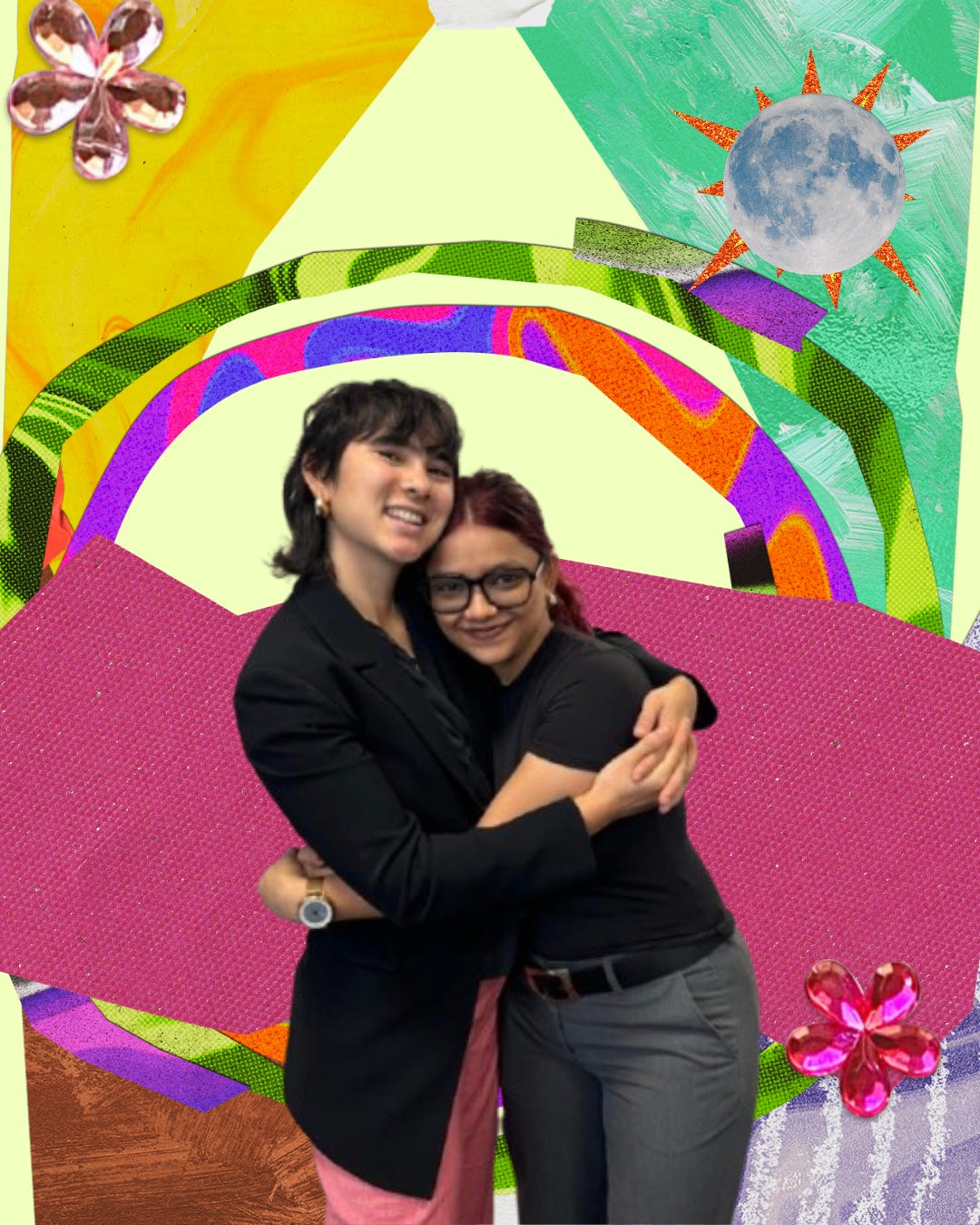
Photo taken of Vrushali and Ly hugging at the UN Sustainable Development Goals Summit, where together they hosted care spaces as part of Community Care Collective in New York, September 2024
When I began The Mental, I knew it was only right to begin with my two co-founders from Community Care Collective (CCC). You’ve already had the good fortune to hear from Raven, so now it’s time for you to get to know the angel herself, Vrushali (she/her)! Vrushali is based in Mumbai, India, and I’ll quote her Substack as an introduction just because it’s so iconic: “[Vrushali is] a queer radical feminist activist and gender justice researcher, always tangled in activism and big feelings.”
I’ll be honest - Vrushali is the mastermind behind all things gorgeous, organised, and well thought-out at CCC. Raven and my impulsive, chaotic, bipolar selves came up with the idea for CCC on a park bench in Brooklyn - to destigmatize mental health and mental illness, prioritize community care, and end the normalization of burnout among youth activists globally - we instantly chose an org name, created an email, and launched the IG all in the same moment (whilst still on the same park bench). It was a true blessing that just seconds later, Vrushali DM'd us to join, saying she had been craving a space like this amongst the global activist community. And just like that, our brains melded and we welcomed Vrushali with open arms as a fellow activist co-founder, and the rest is history - she has been an irreplaceable force, gentle spirit, and loving heart home for us ever since.
I’m therefore thrilled that this second interview with The Mental is with Vrushali. Join us on this journey where we discuss mental illness, activism, and the weight of survival.
-
Ly: Hi Vrush! I’m so happy you’re here to join The Mental for our second interview of the series. Let’s start with an opening question I ask everyone: What is your experience of mental health & mental illness?
Vrushali: I’ve known something wasn’t quite right since childhood, not in a dramatic, movie-scene way, but more of a quiet hum beneath everything. I grew up in a trauma-coded environment: violence at home, unpredictability outside, and survival became second nature. Hyperproductivity, a brain that never shuts up, and this restless, constant stream of thoughts were just “normal” to me, until I was 29, when I realised that maybe peace of mind isn’t a myth, and that some people don’t live like this.
I live with diagnosed depression, BPD and anxiety disorder - the depression feels like it’s very far away these days. The symptoms aren’t always visible, but they shape every part of my life, my health, my relationships, my capacity to show up. I’m what people call ‘high-functioning.’ I can meet deadlines, lead teams, even crack a joke in the middle of a storm. But most mornings feel like mountains. I live in Mumbai, where honking is a love language and overstimulation is part of daily life. My sensory boundaries are constantly pushed. Loud sounds, sudden noises, they take me right back to places I’m best away from - but I often find myself in the midst of them, even in professional settings.
I also carry another quiet weight: I’ve been working since college, freelancing, writing, side gigs, because I had to. Now, I’m the sole earner in my household, and that’s not romantic or noble. It’s exhausting. It’s lonely. It’s pressure that doesn’t clock out. Most of my stress comes from knowing that there’s no safety net, and every burnout threatens not just my wellbeing, but also the roof over my loved ones’ heads. Some days, I dream of retiring at 40, not out of luxury, but pure longing to rest and live a good life. But I know how this economy works. I know what debt does. I know how heavy it is to carry the weight of other people’s survival while trying to tend to your own healing.
I have blank spots, entire chunks of life I know happened but don’t want to revisit. I’m the kind of person who can work all day, deliver beyond expectations, and still feel like it’s not enough. I’m learning to cut myself some slack. I’m much better now than I was. But the journey isn’t linear, nor is it always fair.
Ly: Girlll, I hear you. That is so tough - the alignment of our values of rest and joy (especially queer joy!) but also the messed up capitalist reality of the world. I know we’ve had many conversations about this, family obligations, and just survival in general.
You shared a bit about your context, but can you share more about what the understanding of mental health & mental illness is in your culture? For instance, are you able to open?
I live in India. Here, the mental health “conversation” only really gained traction over the past decade. Even now, the understanding is patchy and shaped by class, caste, gender, and location. Mental illness is still shrouded in silence, stigma, and the constant fear of “what will people say?” When I was 17, my then-boyfriend passed away in a tragic accident. I dropped out of 12th grade. I was already carrying trauma, already grappling with addiction, and that loss cracked something open. My family let me take the year off, not because they understood grief or mental illness in the way Western sitcoms depict caring parents, but because they thought I “needed a break.” That was the extent of emotional vocabulary available.
These days, I can be open, but it’s taken years of unlearning shame and practising honesty. And I still self-edit, especially in professional spaces where vulnerability is sometimes seen as weakness.
Ly: Thank you for sharing, I had no idea. It’s wild how you can be so close with someone, even run an entire mental health organisation together (aka us as co-founders of Community Care Collective!) but not know the deep trauma that each of us hold.
Given what you shared about openness, I’d love to ask: How does the stigma impact you, and how do you feel about diagnoses?
Vrushali: On one hand, it helps me make sense of myself, like I finally have a blueprint for this brain I live in. It gives structure to the chaos I didn’t ask for. But it’s also expensive, exhausting, and sometimes inaccessible. I recently started online therapy because I suspected a neurodevelopmental disorder. I just wanted an answer, yes or no. But the therapist wanted to unpack everything, my childhood, my trauma, my past, and honestly, I didn’t have the bandwidth. I ghosted - and one might psychoanalyse that, and that’s fair.
That doesn’t make me resistant, though. It just makes me human. I want healing, but not through unending consultations that I can’t afford financially or emotionally. Maybe that in itself says something about my mental illness.
Ly: Can you tell me about your experience of activist burnout?
Vrushali: Burnout in activism feels inevitable, especially when you work on issues that are deeply personal. The most recent wave hit during the India-Pakistan conflict, when I was part of a feminist discourse on conflict on both sides. Holding space for grief, rage, trauma, and geopolitics, while also trying to stay informed and sane was quite something. I ended up sobbing for a whole hour one night, while my friends and their families experienced what could have been a full-fledged war - what a confusing fucking time to be alive.
What adds to my burnout, honestly, is something that might sound small - people not responding, not meeting timelines. But for someone like me, who's relied on hyper-efficiency to survive, it’s incredibly triggering. I’m learning to set boundaries, but burnout still sneaks in when the work you do is entangled with your own lived experience.
Ly: You touch on such an important topic here about how we’re all so different in what causes burnout for each of us. As someone who is both your friend and colleague, it has been important to learn the conditions of how you work the best, as well as how Raven and I work too. Running an organisation about mental health, led by 3 well-meaning humans with big ideas and complex lived experience of mental illness is both such a blessing and a challenge, and coming to learn what leads to each of our burnouts has been eye opening and critical.
With this in mind, what do you wish you’d known earlier, and what would you tell your struggling younger self?
Vrushali: That it gets better. Not always in the way you want, but it does. I wish I had been better at academics. I was smart, but the conditions I grew up in didn’t let me be a child, let alone a student. I didn’t get respect, which hurt my confidence, but never my belief in my own intelligence. So don’t you worry, because it gets better.
Ly: Is there a difference from what you’d tell a future self?
Vrushali: The difference is hope. I’d tell someone in the future, especially a young queer person navigating resistance and survival, that being open about who you are and how you feel isn’t weakness. It’s clarity. It’s power. The world is changing, slowly but surely. There’s room now to be honest without apology. I’m proud of how far I’ve come. I no longer hide, but I also am not someone who’d actively announce my queerness. I am okay where I am.
Ly: That’s beautiful, coming to a place of peace with who we are. Is there anything else you’d like to share with The Mental?
Vrushali: I’m deeply interested in what collective care looks like across cultures, especially care rooted in resistance, joy, and community, not just therapy or self-care checklists - things I have learned working with Community Care Collective. I want to study how movements around the world practice collective healing, especially in the global majority. My dream is to write and publish a book documenting these practices. A decolonial, grounded guide for people who do the work and carry the weight, but also deserve to rest, to be held, and to heal.
Ly: That is so very much needed, and I/we cannot wait to read it! Thank you so much Vrush, I love you!
💌
For more, please don’t forget to subscribe and follow @The_Mental_Zine on IG!
Please note that The Mental does not replace any form of professional healthcare, but simple hosts conversations to destigmatise the topic of mental health & mental illness. If you are struggling right now, please know that you are not alone. Please seek support from a medical professional.
If your situation is urgent (and keep in mind, you do not have to be at the rockiest of bottoms to seek help!), please find below a (non-comprehensive) list of suicide and mental health helplines from countries around the world - if your country is not listed, you can google search to find one in your area. These helplines are intended to provide critical, immediate assistance for anyone who may be struggling or needs someone to talk to. If you or someone you know needs help, don't hesitate to reach out to one of these services for confidential support. If you have more to add, please add a comment to this article and we will update this list.
Global Crisis Text Line:
Crisis Text Line (Global, including the US, UK, Canada, etc.): Text HOME to 741741 (24/7, free and confidential support)
United States:
National Suicide Prevention Lifeline: 988 (24/7, free and confidential support)
Crisis Text Line: Text HOME to 741741 (24/7, free and confidential text support)
United Kingdom:
Samaritans: 116 123 (24/7, free and confidential support)
Text SHOUT: Text SHOUT to 85258 (24/7, free and confidential support)
Australia:
Lifeline Australia: 13 11 14 (24/7, free and confidential support)
Beyond Blue: 1300 22 4636 (24/7, mental health support)
Canada:
Crisis Services Canada: 1-833-456-4566 (24/7, free and confidential support)
Kids Help Phone: 1-800-668-6868 (24/7, confidential support for young people)
India:
Snehi: 91-22-2772 6771 / 91-22-2772 6773 (10:00 AM - 10:00 PM IST, emotional support)
Vandrevala Foundation: 9152987821 (24/7, mental health support)
New Zealand:
Lifeline New Zealand: 0800 543 354 (24/7, confidential support)
Youthline: 0800 376 633 (Available for young people 24/7)
South Africa:
Suicide Crisis Helpline: 0800 567 567 (24/7, confidential support)
Lifeline South Africa: 011 242 1911 (9 AM - 9 PM, emotional support)
Germany:
Telefonseelsorge (German Suicide Prevention): 0800 111 0111 or 0800 111 0222 (24/7, confidential support)
France:
Samaritans (SOS Suicide): 01 45 39 40 00 (24/7, confidential support)
Brazil:
CVV - Centro de Valorização da Vida: 188 (24/7, confidential support)
Mexico:
Línea Nacional contra el Suicidio: 800-911-2000 (24/7, free and confidential support)
Japan:
TELL Lifeline: 03-5774-0992 (9:00 AM - 11:00 PM JST, English-speaking service)
Argentina:
Línea Nacional de Prevención del Suicidio: 135 (24/7, confidential support)
Spain:
Teléfono contra el suicidio: 717 003 717 (24/7, confidential support)
Singapore:
Samaritans of Singapore (SOS): 1800-221-4444 (24/7, confidential support)
Pakistan:
AAS: 021-111-22-22-57 (10:00 AM - 10:00 PM PST, emotional support)
learning to give yourself space to rest is such a big part of healing ❤️🩹 couldn’t have said it better myself!
Thank you for giving me this space! This was incredibly therapeutic for me to talk about, and also - the most I’ve ever shared online about my life. Love you, Ly 💜