

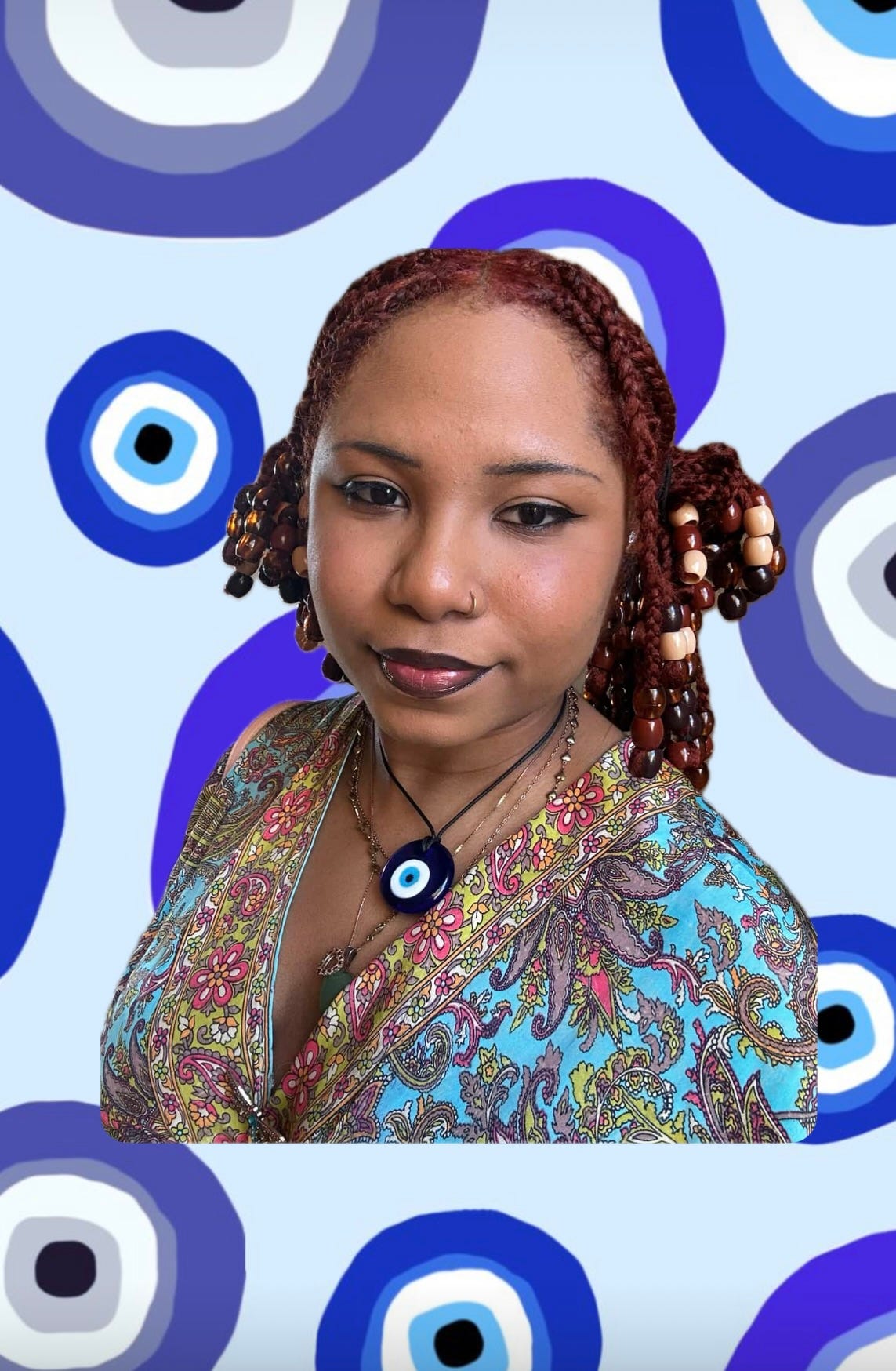
Photo of Sie wearing an evil eye necklace, on a background wallpaper of several more evil eyes!
In this interview, The Mental had the honor to speak with Sie (she/her), a library attendant, advocate and mental health baddie based in Trinidad and Tobago. Sie and I are long-time internet friends, through a few fellow activist mutuals, and The Mental is so grateful for her participation as the third chit chat here on substack!
Sie is passionate about psychology, gender and development, spending time with friends and working on being gentle with herself, which we absolutely love. Sie enjoys the colour orange, amaretto sours, and using her imagination to dream of a better world.
And with that, we’re super excited to chat all things religion, big friendship, grief, and so much more. Let’s get into it!
-
Content Warning: Discussion of suicide
Ly: Hey Sie! To begin, I will ask you what we ask everyone: what is your experience of mental health and mental illness?
Sie: If I had to answer this question last year, it’d be totally different to what I would say now, and even two years ago. My mental health is constantly in a state of flux, and it’s good now. But even as a child, I struggled, albeit quietly. My home life was very strained, for lack of a better word and expressing myself often felt futile.
I also went to Catholic school, and the constant comparison, competition and snideness of the teachers, combined with the regular growing pains of being an adolescent made both me and my peers so fragile.
As a teenager, two friends of mine passed away from suicide, and I saw firsthand how the lack of mental health/illness knowledge can isolate people who are struggling. When you don’t know how to help someone, you kinda just do whatever you believe can, and just keep going until something sticks. And that’s what happened to me. Because of the fear that I would also commit suicide, everyone handled me with kid gloves, when really I just needed someone with whom I could be honest about how I was feeling. And I didn’t really feel comfortable expressing the truth of my mental health because I didn’t want anyone to panic or make a big deal out of it. But the other side to that is I suppressed so much that it came to a point where I’d had a mental breakdown and still had to handle it myself.
Fortunately, when I got to university, I was able to access help and medication, but it came so late that I now have really severe memory loss (that I’m working on healing). For that reason, it’s kind of hard to pin down how I feel really (which is a problem in and of itself) because I just can’t remember. I think there is always an underlying depression I feel, just below the surface, and it’s so easily triggered that it might as well be overt.
After all this time, I believe my parents have accepted that I am generally a fragile person, but still don’t really believe there is anything about me that is different to them (which is a whole different conversation), and I just live with that. My friends however, are much more understanding because of their own struggles. I’d say I have a pretty good support system, that keeps me more stable than not, but everyday is different, and I just take it how it comes.
Ly: I cannot emphasise enough your last point, that healing is not linear, and each day is different, and that dosen’t mean you’ve failed or gone backwards, just that unpredictability is the only predictable thing about life!
Do you mind sharing what your context is, and what is the understanding of mental health & mental illness in your culture?
Sie: I think the culture is slowly, very slowly crawling towards becoming kinder and more understanding. With a lot of public figures that are beloved by, well, the public, coming out and speaking on their struggles, and a rash of suicides that I believe contribute to Trinidad and Tobago having one of the highest suicide rates in the Caribbean, people are almost forced to confront the reality that we are not okay.
Being from a very religious country, you hear talk about the devil/ demons/ spirits/ maljo, a lot. And whatever you believe, there needs to be a reckoning with the fact that mental illness exists within the brain, and with its functioning. Just because it can be and most times is invisible, doesn’t mean that it is caused by forces beyond our comprehension.
I think for the most part people still have a long way to go with understanding mental health issues, but the younger generations know all too well what silence does, and how it creates cycles of illness through families, and are trying to break them.
Ly: How does the stigma impact you? How do you feel about diagnoses?
Sie: I personally don’t feel impacted by stigma, but that is because I grew up being a very vocal person on social media, and with my friends. I accept the people around me and their beliefs for what they are, and I don’t let their opinions invalidate my lived experiences and facts.
I love diagnoses. Diagnoses save lives. It changed mine to have someone look at me and understand exactly what I was experiencing. I also believe in self-diagnosing. The medical/psychiatric system is filled to the brim with people who are dismissive or not up to date with the latest information and so many people go without help. A lot of psychology/diagnosing does not take into account cultural differences (most of it is based on white Americans/Europeans), and so many people get misdiagnosed for that reason as well. If a self-found diagnosis helps people manage, and even heal, I will always advocate for it.
Ly: Would you mind sharing your experience of activist burnout?
Sie: I think I’m in the thick of it right now. Watching lifeless people on my phone for almost two years straight has made a mess of my mind. When I was a teenager, I remember being so resilient; I’d argue with people for days, with my parents and my teachers. Now I can barely stomach the idea of talking about anything that people could argue with me about. I feel like so many people have lost their empathy and it’s hard to stomach most of the time. I’m slowly coming out of it, and remembering why I am the way I am, and why I speak out about injustice, but it’s still hard a lot of the time on me mentally.
Ly: What do you wish you’d known earlier/what would you tell your younger self struggling?
Sie: I probably would have told her that blaming herself and taking responsibility for things out of her control is one surefire way to drive herself crazy. I always wanted to fix things or make sure everyone around me was good at the expense of myself, and it’s probably why she (we, I) is the way I am now.
But I’d also tell her that dreams of the future don’t have to stay that way. You can have wants and desires and you can make them happen and you can be happy. Even if it’s fluctuating, and tedious to maintain, it’s worth it.
Ly: How is this different from what you’d tell someone else in the future?
Sie: It’s not! I’d tell everyone the same thing, and I’d probably just add that it IS that damn phone. Getting off it and being present in your life instead of that of strangers helps so much.
Ly: You’re so right, I truly despise my phone. It is either glued to my hand, or I’ve chucked it halfway across the room as I have so little self-control when it’s right next to me.
Are there any other intersecting areas regarding mental health and mental illness that you want to highlight?
Sie: Grief is such a warper of time and space. It makes everything feel both incredibly important and super trivial at the same time. And it’s never a linear process; sometimes you can be better than you were before the person died, and other times you’re wondering when on earth you’ll feel normal again. It’s something everyone will experience, and almost everyone is seriously underprepared for. Death changes you as a person, and it changed me in ways I don’t think I can even note. Being unprepared for death has been a constant theme in my life, and I find myself grieving before people have even died. In that way I feel like I’m rushing through my life, trying to preempt the inevitable, and even that has affected my mental health.
It honestly makes me laugh sometimes how something so universal is still so shrouded in mystery, and how ticklish everyone is around talking about it. I’m still the person other people in my life come to for advice about to handle death because I’ve experienced the whole process and came out the other side in one piece.
But I think there is no healing from the loss of people or animals you love. It’s just change, and making space for that hurt to be expressed and understood so you can carry on.
Ly: Do you ever look back on how far you’ve come on your mental health journey?
Sie: One thing I ask myself all the time is if I would change the past. I think the answer changes day by day. Every experience you have changes you, makes you the person that you are, whether good or bad. And this isn’t to romanticize my own suffering (which I have many conflicting opinions on), it’s just the truth. If the circumstances of my life hadn’t occurred, I wouldn’t be where I am, or who I am, and I actually do like the person I am/am becoming.
I do wish my friends were alive and could see all the crazy things that happened since they died, and that I could see what their lives would have been like. I think about them all the time and what they would be like as adults, and what I would be like without experiencing their deaths. On the other hand, I can’t change it, and who’s to say that I wouldn’t be a complete 180 on who I am now? It’s a question I grapple with all the time, and there’s no clear answer to me (which also drives me up a wall).
I think being affected by the things that happen in the world (and developing disorders around it) is part of what makes you human. We’re not operating in a world that’s suited for people who aren’t able to compartmentalize and move on or remain unaffected and so many people would not be so mentally unwell if we lived in a better, more equitable and egalitarian world.
If anything, I want the world to be different, softer.
Ly: Thank you so much Sie for your openness, honesty and refreshing perspectives on grief, suicide, and becoming. I am so grateful to know you.
💌
Please note that The Mental does not replace any form of professional healthcare, but simple hosts conversations to destigmatise the topic of mental health & mental illness. If you are struggling right now, please know that you are not alone. Please seek support from a medical professional.
If your situation is urgent (and keep in mind, you do not have to be at the rockiest of bottoms to seek help!), please find below a (non-comprehensive) list of suicide and mental health helplines from countries around the world - if your country is not listed, you can google search to find one in your area. These helplines are intended to provide critical, immediate assistance for anyone who may be struggling or needs someone to talk to. If you or someone you know needs help, don't hesitate to reach out to one of these services for confidential support. If you have more to add, please add a comment to this article and we will update this list.
Global Crisis Text Line:
Crisis Text Line (Global, including the US, UK, Canada, etc.): Text HOME to 741741 (24/7, free and confidential support)
United States:
National Suicide Prevention Lifeline: 988 (24/7, free and confidential support)
Crisis Text Line: Text HOME to 741741 (24/7, free and confidential text support)
United Kingdom:
Samaritans: 116 123 (24/7, free and confidential support)
Text SHOUT: Text SHOUT to 85258 (24/7, free and confidential support)
Australia:
Lifeline Australia: 13 11 14 (24/7, free and confidential support)
Beyond Blue: 1300 22 4636 (24/7, mental health support)
Canada:
Crisis Services Canada: 1-833-456-4566 (24/7, free and confidential support)
Kids Help Phone: 1-800-668-6868 (24/7, confidential support for young people)
India:
Snehi: 91-22-2772 6771 / 91-22-2772 6773 (10:00 AM - 10:00 PM IST, emotional support)
Vandrevala Foundation: 9152987821 (24/7, mental health support)
New Zealand:
Lifeline New Zealand: 0800 543 354 (24/7, confidential support)
Youthline: 0800 376 633 (Available for young people 24/7)
South Africa:
Suicide Crisis Helpline: 0800 567 567 (24/7, confidential support)
Lifeline South Africa: 011 242 1911 (9 AM - 9 PM, emotional support)
Germany:
Telefonseelsorge (German Suicide Prevention): 0800 111 0111 or 0800 111 0222 (24/7, confidential support)
France:
Samaritans (SOS Suicide): 01 45 39 40 00 (24/7, confidential support)
Brazil:
CVV - Centro de Valorização da Vida: 188 (24/7, confidential support)
Mexico:
Línea Nacional contra el Suicidio: 800-911-2000 (24/7, free and confidential support)
Japan:
TELL Lifeline: 03-5774-0992 (9:00 AM - 11:00 PM JST, English-speaking service)
Argentina:
Línea Nacional de Prevención del Suicidio: 135 (24/7, confidential support)
Spain:
Teléfono contra el suicidio: 717 003 717 (24/7, confidential support)
Singapore:
Samaritans of Singapore (SOS): 1800-221-4444 (24/7, confidential support)
Pakistan:
AAS: 021-111-22-22-57 (10:00 AM - 10:00 PM PST, emotional support)
ah thank YOU for hosting this space to be honest! it’s always so freeing to be able to express the truth and i’m glad i got to 🌀🌷🫂