

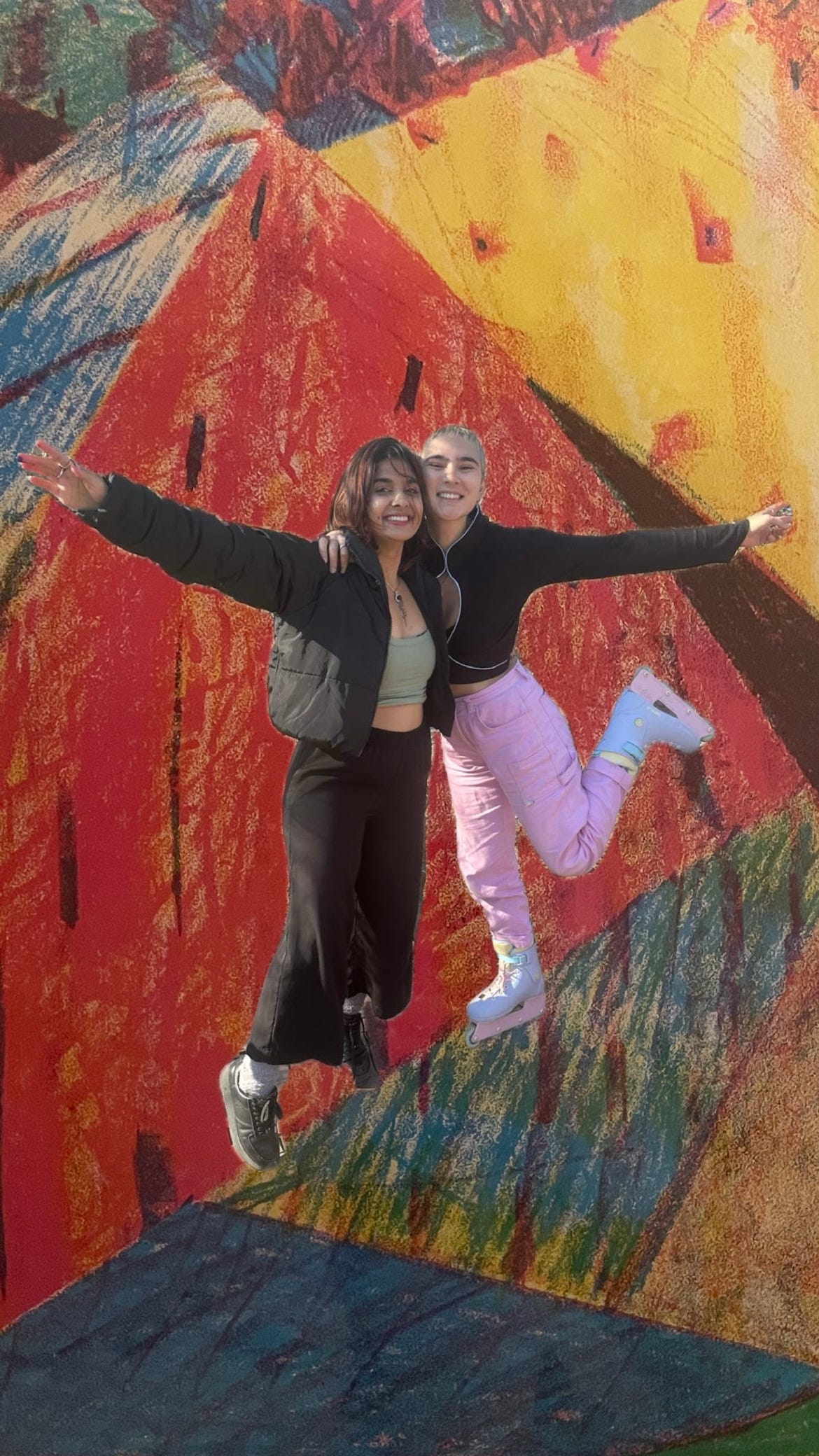
Cover photo taken on the day Raven & Ly began Community Care Collective together, McCarren Park Bench, Brooklyn on March 22nd 2023. Background photo is a 1981 print entitled ‘Butterfly’ by Palestinian artist Samia A. Halaby
Hi Substack,
Nice to meet you. My name is Ly (they/them) and I’m out here with the aim of destigmatising mental health & mental illness (and all the intersectional topics that come with it!) one chit chat with friends at a time.
This first interview is with Raven (they/them), my dear friend and fellow co-founder of Community Care Collective - a grassroots network of global youth advocates we started in 2023 on a park bench in Brooklyn. Our goal is to prioritise community care, radical love, and mental health within social justice movements. Over the past couple of years - and despite living oceans apart - our long-distance friendship has endured, as we’ve supported each other through the ups and downs of our mental health journeys. It was, in fact, our shared diagnoses that sparked the creation of Community Care Collective in the first place. So, it feels only right to begin this series of conversations with Raven.
So without further ado, here is the first The Mental Chit Chat with the legend themself, Raven!
-
Ly: So, let’s start with the basics - what is your experience of mental health & mental illness?
Raven: I grew up with parents who had undiagnosed mental illnesses and often found myself in the role of a carer from a young age. That shaped my understanding of mental health early—through chaos, silence, and survival.
For myself, it’s been a long and messy journey—navigating misdiagnoses, stigma, and trying to make sense of a brain that’s always felt different. I live with bipolar II, borderline personality disorder (BPD), ADHD, anxiety and complex PTSD. I had to fight to be seen — to go my own way and be my own cheerleader to get properly diagnosed as an adult. Every step has been about reclaiming language, care, and understanding in a world that often pathologises people like me.
Right now, I’m on the journey of DBT, medication, and learning to surround myself with what fills my cup—people, practices, and spaces that bring me joy. I believe deeply in a holistic approach to mental health—one that centres community care, cultural understanding, creative expression, and rest. Healing isn’t linear, but I’m learning to move at the pace of my body, not urgency. Taking my time.
Ly: That’s so beautiful, and I couldn’t agree more.
Can you tell me more about what context you live in, and what is the understanding of mental health & mental illness in your culture?
Raven: I live and organise on unceded Aboriginal land in so-called Australia, with Punjabi roots—both Indian and Pakistani. In my cultural context, mental illness is often silenced, stigmatised, shamed, and misunderstood. It’s not something spoken about openly, and that silence can be deeply harmful.
I’ve been lucky to find language and healing in communities — both in so-called Australia and globally. But growing up, and even now, there’s still a deep shame attached to struggle and accepting help. I still carry parts of that with me. I remember going to counselling in high school and my dad reacting by asking if something was wrong with me — saying I was “crazy” for seeking help. He compared my experiences to his own, insisting that because my life looked easier than his, I had no reason to be struggling.
That moment stayed with me. It reminded me how often our pain is measured against survival, rather than acknowledged on its own terms.
In my Sikh Punjabi community, mental health is often misunderstood and rarely spoken about. I remember participating in an exercise where we had to choose which areas of health to focus on. Even though many of us were clearly struggling mentally and emotionally, it was so much easier to talk about physical health. When it came to mental health—especially in spaces where boys and girls were both present—there was hesitation, discomfort, even shame. The silence was loud.
That experience showed me how deep the stigma runs—and how urgently we need culturally safe, gender-sensitive spaces where we can speak about mental health without fear, shame, or judgment.
That experience also reminded me that the environment of the space—and who’s facilitating it—matters deeply. Safety isn’t just about the topic; it’s about who holds the space, how they hold it, and whether they reflect or respect the lived realities of those in the room. Cultural safety, trauma-informed approaches, and community-led facilitation aren’t optional—they’re essential for mental health spaces to be accessible, sensitive, and truly supportive. Without them, even well-intentioned spaces can become sites of harm or exclusion.
Ly: You’re so right. Can you share your experience of stigma and how it impacts you? How do you feel about diagnoses?
Raven: Stigma has made me second-guess myself constantly. It’s made me feel like I have to hide or shrink parts of who I am to be accepted—even in spaces that claim to care. Over time, it’s turned me into a chameleon—adapting to different situations and people, especially where I don’t feel safe or seen. That survival instinct comes at a cost—it erodes authenticity and makes it hard to trust that I’m worthy even when I’m struggling.
I tend to struggle with overthinking—spending way too much time agonising over decisions or the choice of words when speaking to someone. I second-guess myself constantly, even when my initial instinct is clear. It’s something I’m working on: learning to trust my first thoughts, to believe they’re not “dumb,” and to know that I don’t have to over-edit myself to be worthy of being heard.
Getting a diagnosis was both confronting and liberating. I remember cheering—and feeling such deep relief—each time I received a diagnosis. It helped me make sense of my experiences and gave language to things I had been carrying silently for years. It wasn’t just a label; it was validation. But I’m also cautious. Being queer, racialised, and neurodivergent, I’ve seen how systems can weaponise diagnoses—reducing people to stereotypes or using them to deny care. For me, a diagnosis is a tool for understanding, healing, and access—not a box to be confined in or judged by.
Ly: Can you tell me about your experience of activist burnout?
Raven: Burnout is something I’ve known intimately. As someone who came into organising young, I was often holding too much—campaigns, care work, trauma processing, admin—all while trying to survive. Activist spaces often reward self-sacrifice and urgency, which can leave you hollow. I’ve been burnt out to the point of breakdown, questioning everything, needing to withdraw completely. But in those moments, I also found clarity: I don’t want to replicate systems of harm in movements that are supposed to liberate us. That’s where the seed of the Community Care Collective was planted—on a park bench, with fellow burnt-out friends, dreaming of something softer. Something that centred care and sustainability in our organising.
Ly: What do you wish you’d known earlier/what would you tell your younger self struggling?
Raven: I’d tell them: You don’t have to earn or prove your worth through overwork. You are already enough. Rest isn’t a reward—it’s a right, and it’s resistance. Your softness is not a weakness. You’re allowed to take up space.
You are never alone. Even when your mind tries to convince you otherwise—even when the inner critic is loudest—your inner champion is still there, steady and strong, ready to carry you through. Trust that voice. Nurture it. Let it grow. Believe in yourself—and believe that the universe is on your side, because it most definitely is..
Though it most certainly sucks, your darkest days exist so that you can fully cherish and make the most of your brightest ones.
You are a sun—radiant, powerful, and full of light. And just like the sun, you deserve rest. You deserve time to recharge, so you can rise again and shine another day.
Ly: How is this different from what you’d tell someone else in the future?
Raven: This question hits especially hard right now—during a time where I’ve really noticed how much I give compared to what I receive. I’m always doing, always loving, always holding space for others.
The truth is, I’d tell all these things to someone else in the future—probably even before I’d tell them to myself. I’d be the first to remind others of their worth, their right to rest, their light. But when it comes to me, I hesitate. I’m learning, slowly, that I deserve the same love and softness I give so freely to others. That I can be both the giver and the receiver.
And to that, I’d tell someone else in the future: You are not too much for this world. You are allowed to rest. You are allowed to receive. You are allowed to be held.
You don’t have to be everything for everyone to be worthy of care. You are enough—even when you’re not giving, doing, fixing. Let yourself be loved, not just for how you hold others, but for who you are when you’re held too.
Ly: What other intersecting areas do you want to highlight?
Raven: Mental health doesn’t exist in a vacuum. It intersects with race, queerness, gend
er, disability, climate grief, and migration. For people like me—queer, diasporic, neurodivergent—healing is also political. It’s about reclaiming our right to feel, to rest, to dream, and to exist beyond survival. We can’t talk about mental health without talking about capitalism, colonialism, and the violence of invisibility.
Episodes of mania and depression can be terrifying—lonely, disorienting, and overwhelming. They distort time, memory, and reality. In those moments, it’s easy to forget that the storm will pass. But it does. And it will.
To anyone going through it: Trust that you will make it to the other side. You are not broken. You are not alone. Even in your darkest hour, there are people, ancestors, and possibilities holding you, whether you can feel them or not. There is life on the other side—and it’s worth staying for.
Ly: Raven, thank you for being such an inspiration, a shining light and a gentle soul with the biggest heart. I love you!
💌
For more, please don’t forget to subscribe and follow @The_Mental_Zine on IG!
Please note that The Mental does not replace any form of professional healthcare, but simple hosts conversations to destigmatise the topic of mental health & mental illness. If you are struggling right now, please know that you are not alone. Please seek support from a medical professional.
If your situation is urgent (and keep in mind, you do not have to be at the rockiest of bottoms to seek help!), please find below a (non-comprehensive) list of suicide and mental health helplines from countries around the world - if your country is not listed, you can google search to find one in your area. These helplines are intended to provide critical, immediate assistance for anyone who may be struggling or needs someone to talk to. If you or someone you know needs help, don't hesitate to reach out to one of these services for confidential support. If you have more to add, please add a comment to this article and we will update this list.
Global Crisis Text Line:
Crisis Text Line (Global, including the US, UK, Canada, etc.): Text HOME to 741741 (24/7, free and confidential support)
United States:
National Suicide Prevention Lifeline: 988 (24/7, free and confidential support)
Crisis Text Line: Text HOME to 741741 (24/7, free and confidential text support)
United Kingdom:
Samaritans: 116 123 (24/7, free and confidential support)
Text SHOUT: Text SHOUT to 85258 (24/7, free and confidential support)
Australia:
Lifeline Australia: 13 11 14 (24/7, free and confidential support)
Beyond Blue: 1300 22 4636 (24/7, mental health support)
Canada:
Crisis Services Canada: 1-833-456-4566 (24/7, free and confidential support)
Kids Help Phone: 1-800-668-6868 (24/7, confidential support for young people)
India:
Snehi: 91-22-2772 6771 / 91-22-2772 6773 (10:00 AM - 10:00 PM IST, emotional support)
Vandrevala Foundation: 9152987821 (24/7, mental health support)
New Zealand:
Lifeline New Zealand: 0800 543 354 (24/7, confidential support)
Youthline: 0800 376 633 (Available for young people 24/7)
South Africa:
Suicide Crisis Helpline: 0800 567 567 (24/7, confidential support)
Lifeline South Africa: 011 242 1911 (9 AM - 9 PM, emotional support)
Germany:
Telefonseelsorge (German Suicide Prevention): 0800 111 0111 or 0800 111 0222 (24/7, confidential support)
France:
Samaritans (SOS Suicide): 01 45 39 40 00 (24/7, confidential support)
Brazil:
CVV - Centro de Valorização da Vida: 188 (24/7, confidential support)
Mexico:
Línea Nacional contra el Suicidio: 800-911-2000 (24/7, free and confidential support)
Japan:
TELL Lifeline: 03-5774-0992 (9:00 AM - 11:00 PM JST, English-speaking service)
Argentina:
Línea Nacional de Prevención del Suicidio: 135 (24/7, confidential support)
Spain:
Teléfono contra el suicidio: 717 003 717 (24/7, confidential support)
Singapore:
Samaritans of Singapore (SOS): 1800-221-4444 (24/7, confidential support)
Pakistan:
AAS: 021-111-22-22-57 (10:00 AM - 10:00 PM PST, emotional support)
“…healing is also political. It’s about reclaiming our right to feel, to rest, to dream, and to exist beyond survival.” yeah…yeah… exactly! so beautifully said 🧡