

This week I had the honor to interview a new friend, Micha (he/they/we) for The Mental! We met a few weeks back, after both responding to a Lex post (shout out Lex, queer messaging board app, useful for literally all things queer) about being panelists at the opening of ‘All That I Am: featuring stories of hope and resilience’ a pop-up art show about mental health by Monica Rahman. So there we were, sitting up on stage as panelists, talking all things mental illness, family, trauma – the usual! We quickly realized that each of us on the panel, including the host, were queer biracial Asian-White (Micha is Japanese-German, Monica is Bangladeshi-American, I am Chinese-English) which is a really wild coincidence. It was especially important to me because my mum was there in the audience, and when I spoke about cultural stigma about mental illness, it meant a lot to have her there – and I even turned one of the questions over to her in the audience about how to support loved ones when they are struggling with mental illness. All in all, it was a very meaningful night, and I’m so grateful that I got to meet Micha out of it. I found myself nodding, snapping my fingers, and scribbing down notes the whole time Micha was speaking. After that night I just knew that 1) we had to become friends and 2) that I had to interview him for The Mental!
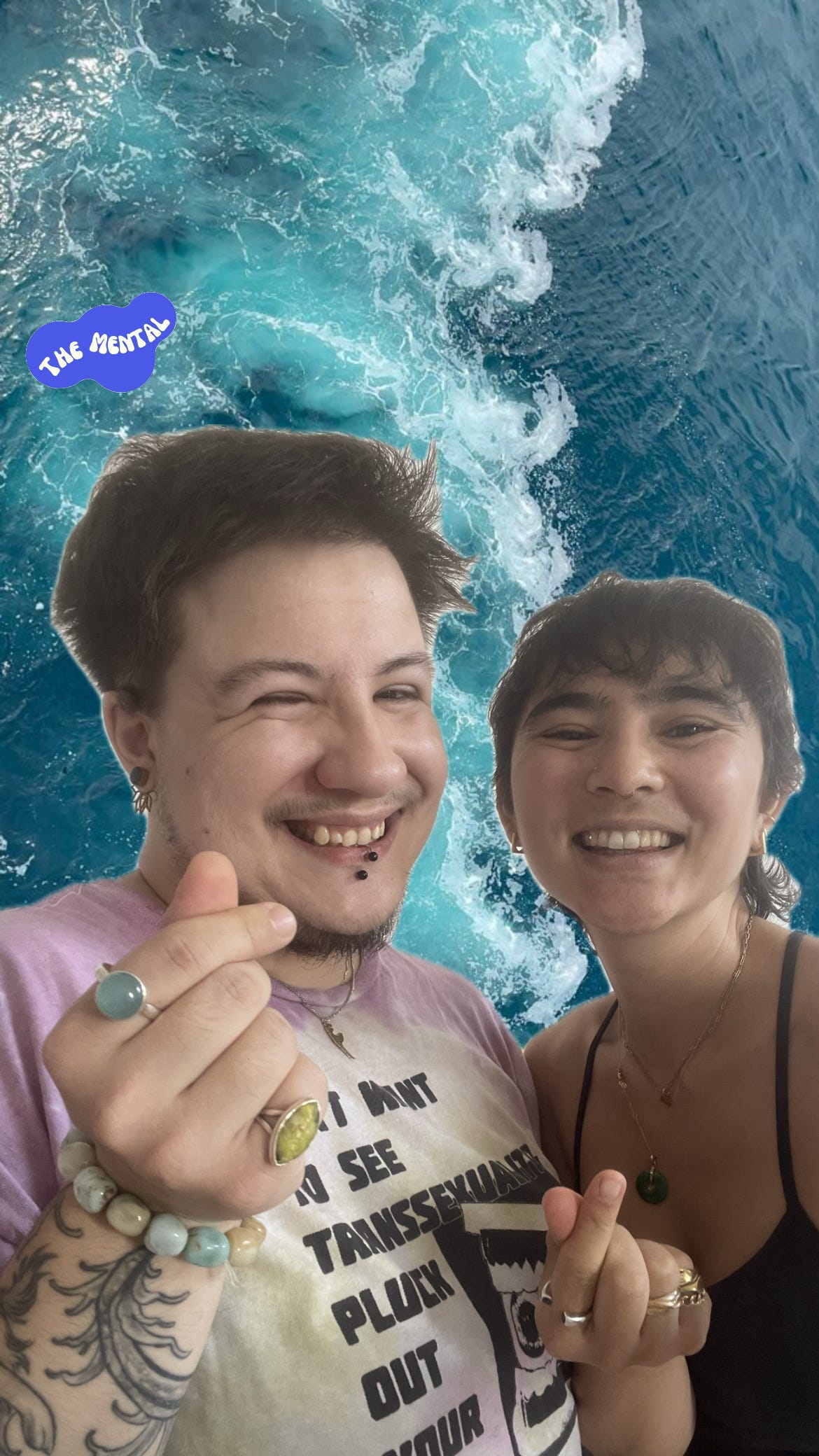
I absolutely loved having this conversation with Micha (as my cat was dutifully busy making bread right between us), and I learnt so much.
So without further ado, here’s round 2 of Micha-Ly time – enjoy!
-
Content warning: discussion of suicidality
Ly: What is your experience of mental health and mental illness?
Micha: I have a lot of personal and professional experience with mental health. In a really simple way, every person has it so if you are, you know, a cognitive person and you're out here thinking stuff, you probably got some mental health and the big way it started way back with my family in particular, they were anti going to doctors, and anti-medicine and so that included also being anti mental health. I think that some of the solutions that my family then pursued were really kind of particular to us, for instance when I was around four years old I was diagnosed with autism but my parents weren't really thrilled with that diagnosis so then instead they brought me to a spiritualist and they said that I was possessed and so I was a part of an exorcism at age 4, trying to remove the ghosts from me - which really they should have done it on my house - as in my opinion I was ghost free, I was just autistic but pretty early on I realized maybe that sometimes when you act a different way or you feel about things a different way there is a punishment and a context in which you are not supposed to feel, and so I think in the big journey of life, I always think back to that early moment and talking about mental health because in a very real way it's our naturalist part of being and so trying to figure out how we're going to live with that and how we're going to help each other live with that has been my lifelong mission since then.
Ly: I love how you said you were ghost free but just autistic, and I really like to think that you said that age 4.
Micha: ohh yeah absolutely.
Ly: I also love that when we were on the mental health panel a couple of weeks ago and how it turned out that just randomly all half Asian-half white and I was wondering when you talk about your parents and they how they dealt with your autism, do you feel like that was in any way related to your culture given I know your family are from two islands especially?
Micha: I alluded to it a little bit and in saying that my family was weren't huge fans of doctors but to kind of dig into that, what it really meant was that my family on my dad's side [from Okinawa] I wanna say, 6 generations deep of spiritualists, and in particular my dad and my great grandmother were really involved in this Christian Shinto spiritualist cult in which you know, mental health but also all forms of health, are kind of seen as like a spiritual illness or like bodily illnesses, like a moral illness so to speak and so I think that it really changed what it meant to them to be approaching a doctor in general. Then I also say that on my mom's side, she's German and Jewish, and so being only you know 2 generations removed from the Holocaust, my family was also very against institutions in general so it also just so happens that that side of my family is also spiritualists but on that side, my grandmother is an herbalist she learned it from her grandmother you know and so on and so on and so on both sides really there's just kind of a really long running institutional distrust whether it's something that comes from being something that comes from being spiritually or culturally oriented towards these things and so when I think about what it means for my own culture to be influencing my views on mental health I think that I have kind of this unique perspective where I am both deeply embedded in the system like I am a mental health worker now.
I do crisis work across the country and also I hold a lot of space for kinds of healing that don't necessarily happen in clinical spaces because that's largely what I saw in my friends and family doing and so I really tried to hold on to some of those positive pieces as well where you know, I wouldn't have learned that doing Tai chi is so good for my mental health if I weren’t, I love to see the aunties going out and doing it in the park once a week sometimes multiple times a week, and maybe there's something to it, maybe there's something I can engage in here and so I think in a very broad way yeah my perspective is wildly different than my average white counterpart in the New York social work world.
Ly: It is really interesting that both sides of your family are spiritualists - do you think that's something that they bonded over, even though your father is from Okinawa and your mother is from a German island?
Micha: Yes, my father is from Okinawa and mother is from an island just above Germany called Westerland/Sylt.
Micha shows Ly his forearm tattoo that beautifully depicts Westerland/Sylt
Micha: So there is a lot of mutual respect and conflict that comes from that shared islander background. We all did the exorcism together when I was young so in those kinds of ways, you know when things get serious, my family was very good about bridging culture and coming together and at the same time these are literally two islands on opposite sides of the earth, so we had a lot of cultural understanding and interchange but there was also definitely some budding of heads around the place of spirit around what kind of spirit should be in the home, and lots of big opinions regarding Christianity for lots of reasons, but I think that that certainly was a huge part of grounding myself in my own understanding for how we come together to get to wellness.
When I was itty bitty, everyone was really on board with me having been possessed - they did not check with me, but everyone else in my family on both sides were super on board. They did the whole exorcism and I think they did clear some of the spirits in the house, but I continued to be autistic to this day so believe it or not, they kind of missed the mark on that I hate to tell you.
Ly: Got it, got it. Well I’m glad some spirits were cleared at the very least!
What has been your experience of mental health stigma or coming out about your mental health?
Micha: I think mental health stigma is very very strong within my family for the reasons that I mentioned. You know, we don't really go to doctors, and in addition any kind of malady is seen as a personal failing so there's a lot of shame that's baked into the idea of needing help at all and I think that also comes from both sides of my family having these cultures of this kind of absolutist excellence. You know when you think about Japanese imperialist nature, it's very perfectionist oriented and I think that white German nature is the same way - it's kind how the hand of fascism always looks the same kind of vibe.
So myself being a disabled person and being so at odds with fascists, I think that stigma is the most natural thing to come out of this culturally, and again we talk about fascism being a way to control, to monitor and to create particular expectations for how folks are feeling, thinking, doing, acting etc. and so when you invent that kind of structure, and more often than not if you are someone other than a white cisgender heterosexual rich totally abled (whatever that means) man, you're gonna be the other and so when we think about stigma if you are anyone other than that person that I described, there is a stigma in you not completely succeeding in whatever this trap of fascism is and so that's when we need things like help, that's when we feel things like shame, that's when we feel things like sadness, like anger, frustration.
All this to say that stigma is another tool of fascism you know it's another way of preventing us from seeking out help in each other for seeking out wellness for each other and from really creating community to deal with some of these bigger feelings whether it's personal sadness or collective communal trauma and in both ways the purpose of stigma is to prevent us from gathering because gathering in a collective is a really important way for folks to actually heal, so if we are unhealed then we're going to keep buying stuff to try and heal etcetera etcetera - it's really functional in that kind of way, so stigma I will say is a big money maker and that is kind of my final definition on that.
Ly: FACT. I couldn’t agree more, because when I talk about community care and wellness and looking after your mental health, I always talk about it from this anti-capitalist perspective of how you don't have to buy shit to look after your mental health, but I never thought about it in terms of how stigma is profited on and an arm of the capitalist machine.
Could you speak a little bit more about fascism, given what we're going through in this country right now, and how that impacts mental health and mental wellness.
Micha: Yeah absolutely, I mean I think you teed it up - the rise of fascism in this country is affecting everyone you are not immune to the rise of fascism and in turn people are feeling unwell because fascism wants you to feel unwell even if you are the most privileged person it is to the benefit of fascism the capitalism that you dislike yourself or the state that you're in because then you will spend money to change it so very literal way that's how we get into the money making time moment of it.
A lot of free mental health is deeply stigmatized and it is usually stigmatized because of class and race, and when we talk about things that are free mental health we're talking about the aunties in the park, playing music getting a drum circle with your friends - this kind of things are for the most part - barring equipment and space etcetera – free, and they're also mostly things that people of color and also mostly things that poor people of color do, and so when you think about these free things to improve your mental health and to improve your well-being there has to be a culture of shame around these things to prevent us from doing them, to reinforce the unwellness and so it's one of those things where, to go back to the drum circle how we think about different kinds and ways of anti-blackness that can interrupt and me and my friends going down and having a drum circle, and so when we think about the way that folks of color are not allowed to gather especially in large numbers there's always going to be some sort of surveillance whether it's a formal police presence or just a white person keeping an eye on it and it's really difficult for us to find the time and energy.
Fascism is intentionally overworking us, so when we talk about what do we do about it given we’re in this kind of collective crisis and thinking about what are we going to do, the easiest answer is to find ways to rest together and find ways that you're kind of already doing it. You will be so surprised how much community care you're actually already involved in.
I always think about when I moved into my old apartment, the first thing that I did is I had a whole bunch of note cards and magnets from the local crisis line and I went door to door to every Barber Shop within a 5 block radius and I greeted the owner and I explained ‘Sir, I know you are the expert on mental health in this area so can I offer to you this thing that I do’, and I sat there and I chatted with folks and some of them had questions, some of them just flat out said no and that's fine, but the point is they're already community leaders who are looking out and caring for people. So what we can do is 1) find them, 2) support them and then 3) acknowledge that they’re leaders - a lot of folks don't realize that they're already deeply involved in community care, it's just not called that.
Ly: I think about that all the time because in the neighborhood where I live there's many Barber Shops and they're always open till like 3:00 AM and when I walk home the end of the night they're just like all hanging out, all pals in the shop sitting in the barber seat getting their haircut, or not, but it's just a place to gather and be together. Are there other spaces like that which people wouldn't traditionally associate with community care? Can you also talk about the academisation of terms like community care, mutual aid and mental health?
Micha: I think there's a lot of different ways that we can think about our well-being in and outside of the institution, I mean even what we were just talking about how you have your folks at the Barber Shop, but I'll take a step further – where I used to live, there was this old Persian man who ran the corner store caddy corner from my building and we chatted it up every day. We were always talking about this that and the other, he was even trying to set me up with his fucking nephew like, we were deeply embedded with each other, and I remember one time I came by and I hadn't been by in a while and he asked where I’d been, and I told him my dad was in the hospital in a coma, and he just grabbed me by the shoulder and he said if you need to cry I'll just open up the desk and you can come sit here and cry, no questions asked. I just broke down sobbing, I didn't even make it to the behind the desk but that really meant the world to me and so you know, when we think about these kinds of things and community care it's kind of very literal you know.
I think that in this day and age a lot of folks want some kind of mystical magical you know consistent way to interact with everyone all the time that will always work and will always be beneficial for everyone's mental health but I think the need for an academic standardization of wellness is exactly the opposite of wellness so I think understanding how you have to be embedded in these things is really the spirit of it, and then whatever words you want to call it is up to you.
I think a lot of people are doing a lot more community care and community work than they realize because they don't call it that you know when we when we're out here trying to get the grant funding and when we're out here writing about our evidence-based practices or all these kind of academic things that really live in a conceptual place, this is wonderful and it's important to write these things down and to understand them from that perspective, but the nature of abstraction is that you're always going to lose something and so when we're trying to abstract them from the actual human connection that we can have between one another, that's really where we get lost so I think there is this real fervor to try and quickly define what components of the cultures of people of color have made us so resilient over these years and to define them broadly. My response to that is it's much more individual and much more reflective than we think so when we think about it again, what does it mean to have all this existing in an academic body and psychology and sociology or however you want to place it, as it's always just going to be missing the mark.
Ly: I work in the NGO industrial complex myself, and I agree - writing proposals for funding is like trying to get yourself in the brain of a generic white project officer of foundation, and I think about how much of a service it would be to provide grant writing services to community members, because so often the people who are actually doing the work are providing the service a million times over but not getting money or not even knowing where to look or not even knowing they could get money for something like that.
Micha: I think that that is a very common thing, where you could either do good work or get all the money. I'll shout out some folks like Astraea [Lesbian Foundation for Justice] for instance who really make an effort to make sure that it is slightly less harrowing to try and acquire money to help people but yeah it is unfortunately super true. if you can afford to hire a grant writer you're probably a large enough organization where the grant writer is not directly involved in the work and then the flip flop of that is a lot of folks who do this direct work don’t have the capacity in their day to stop and do some grant writing - they're seeing 20 clients a day so then we got this really interesting intersection where a lot of the folks who are trying to run the kitchen don't know how to make all of the dishes. That is a pet peeve of mine having worked in very many kitchens, so what I'll also say is part of the solution in my opinion is this really wonderful shift towards peers and sort of experiential learning and experiential leadership so a peer is in a very literal sense someone who has experienced something and is now going to harness the skill a modality anything of that nature to then further along research solutions, investigations anything of that nature so it's a really pretty broad category.
When we're thinking of mental health in particular, it's someone who has had some experience with their own mental health or the mental health of a loved one who is very close to them and someone who is interested in taking that and actually transforming the work with it whether it is working directly with folks or working in these more administrative capacities, so in the perfect world we could have a peer who has felt these emotions who understands what it means when we talk about suicidal ideation and crisis and also has the time and allocation to do some grant writing, so I think that really is one of those spaces where we get to bridge the vast chasm between folks who receive mental health services and folks who write about us.
Ly: Couldn’t agree more. Could you share a bit more about race and mental health?
Micha: I like to always tell the story from way back when I was in college and I was trying to tell my dad what I was studying, and so I kind of explained it and he told everyone I was doing social psychology, when what I was really doing was digital interactive theory and neuroaesthetics, so neurology-comp-sci-art kind of combination, but he was like social psychology close enough. It's so funny to me because when he finally understood what's happening, he was like ohh so it's like for therapists but not, I was like yeah sure close enough, and he was like ohh I know you got that from your mom's [white] side. He was like I just think it's a white people thing. So when we talk about stigma, that really lines up with a lot of folks experiences. So when you come in and you're talking about mental health, others, like my dad are more like ‘I've been too busy being colonized or enslaved - we don't take things like mental health that seriously’, but mental health is still around, we still get trauma from everything that has happened all the way back, and when we talk about what to do with it and we're exploring things around different kinds of community care that we're trying to usher into these really specific molds for what we can say about mental health and well-being.
I was invited to sit in on a sweat as a part of trauma work with a youth, and some white person was like ‘ohh I just think it's so wonderful that we're getting back to indigenous ways and practices of healing’ and it's so funny to me because I just have never heard a not white person call it that. I think only white people say ‘indigenous ways of healing’, but we just call it what we do.
Ly: Ok, part of me wants to be like it's Pride month!! Then part of me is like fuck, I don't care about corporate prideTM, its pride for us 365! But then I'm also just reading your T-shirt that says ‘Don't want to see transsexuality? Pluck out your eyes!’ with an amazing illustration of a false set of teeth that looks like those chattery ones that you wind up, whilst it is eating an eyeball, which is iconic, so in that vein, I was wondering if you wanted to talk about queerness, transness, mental health and anything else you wanna treatise about this rainbow corporateTM month?
Micha: Oh my God, I love that first off, and I have to say full credit to Sweatermuppets on IG - I've been following them for like 7 years so they made this shirt which I love, but yeah thinking about gender and mental health, I think it is no secret that when you spend a lot of your life being a gender that does not feel good in your body and performing that gender that you might not feel so good about it, but I think that broadly, people talk a lot about trans folks and suicide, and so I'll take a moment to speak on that being someone who's literally an expert in both, and I want to emphasize that it's not all doom and gloom to be transgender, and it's not all doom and gloom to be queer. It's actually an immensely joyful and liberating thing when you feel like you get to know yourself in a correct and honest way whether or not you get to have all the fancy frills and have a haircut, start HRT, have a new wardrobe, and all these things - those are all good as well, but I think there is nothing in the world that can replace just the beautiful self-assuredness of being transgender, and there is something really poignant in being told for so long that you are one thing and then choosing to be another – like you were always going to be that thing that you chose, but the fact that you get to exercise agency upon yourself in this world is an exceedingly rare thing, so I always have to give the shout out to us trans folks.
We talk a lot about how we are so made vulnerable by this world, but I think that there's also a special bonus skill which I think especially comes out during pride, that is this kind of beautiful like fuck you, I've already constructed who I am despite who you see me as and that's a pretty radical place to be and especially thinking about mental health, it’s having that kind of agency for yourself, and beyond that, being able to wake up and say today I chose myself again, that's really big you know. I mean when we talk about working through things like depression and complex trauma, there's a lot of reasons why folks may not want to continue doing that work - it's hard, but when we think about trans folks who also have depression, who also have complex trauma, one of the main things that helps us get out of bed is that we get to be a person who we like and that is already much much more than a lot of folks can say about themselves.
Ly: That’s so beautiful, especially at a time when it's getting harder to be trans in this country, I saw that the Transgender Law Centre posted that nearly 50% of trans folk in this country have relocated or considered moving to a more affirming location, and it's so important that people recognize the pain of this time but the duality of the pure joy of being trans and queer, and how much that does for your mental health, and so by taking that fundamental human right away, it's just evil as it rips away the joy of being the person that you are that you know yourself to be.
Can you talk a little bit about your experience growing up? On the panel we were on, I remember you discussed your childhood in poverty and the challenging circumstances in which you became a sex worker at a young age, and how do you think that relates to your experience of mental health?
Micha: I still think until this day about my my queerness and sex work. I was fortunate enough that I was very young to have realized that I was queer around the age of 12, and it was a really beautiful thing. I literally had a dream where Sandra Oh appeared and then we made out and then I woke up. It's funny too because it was like I was 12 and at the time most people only knew her from Grey's Anatomy, and I had never seen Grey's Anatomy so I can't emphasize enough how I really just kind of cherry picked her. Knowing I was queer early on led me to kind of this deep self that I still hold strong to, and that was a part of me long before I knew I was queer, and was always an emo kid, but this also opened the doors to an alternative to giving up.
I was quite young when I experienced my first suicide attempted around 11 and they were for the most part nonstop until I hit around 19 or 20, but within that range what I learned is that it's either that you're going to do this or that's the end, and so I felt that I was in that situation all the time and that learned behavior really stuck with me, so then going into starting sex work at a young age, initially I was lucky enough for it to be mostly with other queer people and that was a relatively safe sort of situation which didn't last very long, but it was a safer entry to things. I still think about those early days.
I was 14 at the time, and it is a pretty pivotal time of learning about yourself and learning about what the world means, but beyond that I was at a moment when I was learning myself and then I had to very quickly learn that my body did not belong to me and I think being someone who is white and Asian and was raised feminine, there are always a lot of elements of how I was expected to behave. I was expected to be seen but not heard. I was a slightly darker tone than my brother so I could go play outside when he couldn't, and all those kinds of things and so I think that was really reinforced in me right when I hit puberty at 14, because of sex work, because I was literally an object to be marketed, and by god was I trying to market and just desperately try to make money to make rent, to get groceries, to buy school books, anything you name it and it's something that I actually had to do for 11 or 12 years, so it's a very long time and I think that I'm for many reasons very traumatized by that experience, but I think it really in particular made me sensitive to what is a life or death kind of crisis.
Having to experience that and then when I went to college briefly having to experience homelessness, I think that that kind of sturdiness really stuck with me not just because I had survived so many things but because so many of my friends had not. I have so many of their dreams within me and so many of their hopes on my shoulder and a lot of ghosts on my shoulder. This is why I always call myself a storyteller, because I know what I learned in college wasn’t from the books, but almost everything I know about how to save a life I learned from watching others not be so lonely and so in that way I I really credit that part of my life and the people that I met in that part of my life with why I got into crisis work and why I'm able to still do it. It is because in a trite way, it's just not about me, and allowing it to not be about me for a little bit actually makes it so much easier, and that gave me that perspective that I still carry with me to this day. Thinking about agency, thinking about fea,r thinking about the things that folks carry with them when they come in through the door for help, all of and how to deal with it are things that I've learned from folks in that time of my life.
Ly: As someone who works in crisis work, how do you look after your mental well-being and your mental health?
Micha: yeah, I'm bad about it I'm not gonna lie! I'm gonna own up - but I think the most important thing to me is the focus of my life. I have really tight friends and found family, predominantly because most of my blood family is not thrilled with who I am, so I have my brother who is with me and then I have a very tight circle of found family and all of these people mean the world to me. My dad always said the most important thing in life is other people and so I really grew up holding that true in my heart and I think it's still true to this day that if I can talk to someone who I care about, even if I'm having an awful day, even if we're not talking about my awful day, and especially if we're not talking about my awful day, I find that it really brings me back. There's a willingness in my heart and a curiosity towards the future about what will happen to the people that I care about. Making it not about myself makes it a lot easier, but also being willing to involve myself in their lives, being a part of it with my little sister where I will also go and babysit or whatever when she's out on date night, or maybe I'm flying all the way out to Illinois to go and check in on my friend and her mom. I find that being embedded in community and embedded in the lives of other people is what sustains me, so with all of this dark scary tragic violent fascism, I still remind myself that there is this group of very very passionate fags who are not willing to let it go.
Ly: What advice would you share with a younger self?
Micha: Definitely get checked for cancer, and do not listen when they tell you it's trauma - it's cancer. Yeah, that is probably the headliner. Then I'll also throw in by the way your trans. Everything else I think I would just simply have to live through to figure it out.
Ly: What are the different kinds of crises you work on, and what resources would you point people towards?
Micha: The term crisis is a really broad term, and I think therein lies the answer. So many things are a part of crisis work, and a lot of folks think that every crisis hotline is the same and it's not true. For instance, there's the 988 line which is formerly the National Suicide Hotline - it's now the national Suicide and Crisis Line, and it's a 3 digit number that you can talk, or text or digital across the entirety of the continental US Alaska Hawaii Guam Puerto Rico and Samoa (though if you're in Samoa you might have some issues with texting, which they are working on). I will also note that this is a hotline which has an imminent risk policy, where if folks seem like they are about to hurt themselves or someone else they will call in a first aid specialist which for most of the country is going to be the police which is important to know.
There are also a couple of other support services out there for instance for trans folks like myself. Trans Lifeline is an excellent resource nationwide, and I believe they also have an additional line for Canada these days (U.S. (877) 565-8860 or Canada (877) 330-6366) and they do not call the cops no matter what - that is their policy.
If you're in New York City we have the NYC Line you can also reach them by calling 988 but are little bit different than your average bear. We also have mobile crisis teams where you usually have a social worker like a psychiatrist or a peer, but it's really just kind of all mental health people and then that team goes out and visits you. You can only call it for yourself but it is an exceptionally useful alternative then you know if you're feeling suicidal and then calling the police, which often can end in suicide by cop, so it’s just a different crisis resource which offers different options. Of course, not every crisis is about mental health and not every crisis is about suicide even if it is about mental health so there's all kinds of other resources for folks to consider. In New York I'm thinking of The Center which is the LGBTQ+ Center which is a huge resource hub there I'm also thinking of The Jewish Board which is another great one for transitional housing. Last but never least, if you are under 25 and you are queer or trans or not - we won't check - \ you can get free therapy through the Queens Affirming Youth and Families Alliance where there is a team of 1 clinical worker and 1 peer running individual and group sessions totally for free. You can meet up once a week you can meet them every other week, it's up to your discretion and schedule, and they do online and in person so that is my big plug behavior.
Ly: As a final question I wanted to ask what's bringing you joy these days?
Micha: I'm really really excited to be hanging out with all of the queer and trans folks of color in my life because it feels important now more than ever to find the joy in each other and to remind each other that the joy is there with us, so you know things like coming to chat with you, or later tonight going to do an artist collaboration with Zai where I get to go and run their fancy projector work. Then next week I’m going to go and be a part of a queer film thing, and just being able to hang out with folks who are still pursuing something joyful in each other in spite of all - that's where I hang my hat.
Ly: That is so true and so beautiful! Thank you so much, you are such a fountain of knowledge and wisdom and joy.
I'm so grateful that we met and that we got to have this beautiful conversation. Shout out to Monica (and Lex!) for bringing us together!
💌
For more, please don’t forget to subscribe and follow @The_Mental_Zine on IG!
Please note that The Mental does not replace any form of professional healthcare, but simple hosts conversations to destigmatise the topic of mental health & mental illness. If you are struggling right now, please know that you are not alone. Please seek support from a medical professional.
If your situation is urgent (and keep in mind, you do not have to be at the rockiest of bottoms to seek help!), please find below a (non-comprehensive) list of suicide and mental health helplines from countries around the world - if your country is not listed, you can google search to find one in your area. These helplines are intended to provide critical, immediate assistance for anyone who may be struggling or needs someone to talk to. If you or someone you know needs help, don't hesitate to reach out to one of these services for confidential support. If you have more to add, please add a comment to this article and we will update this list.
Global Crisis Text Line:
Crisis Text Line (Global, including the US, UK, Canada, etc.): Text HOME to 741741 (24/7, free and confidential support)
United States:
National Suicide Prevention Lifeline: 988 (24/7, free and confidential support)
Crisis Text Line: Text HOME to 741741 (24/7, free and confidential text support)
United Kingdom:
Samaritans: 116 123 (24/7, free and confidential support)
Text SHOUT: Text SHOUT to 85258 (24/7, free and confidential support)
Australia:
Lifeline Australia: 13 11 14 (24/7, free and confidential support)
Beyond Blue: 1300 22 4636 (24/7, mental health support)
Canada:
Crisis Services Canada: 1-833-456-4566 (24/7, free and confidential support)
Kids Help Phone: 1-800-668-6868 (24/7, confidential support for young people)
India:
Snehi: 91-22-2772 6771 / 91-22-2772 6773 (10:00 AM - 10:00 PM IST, emotional support)
Vandrevala Foundation: 9152987821 (24/7, mental health support)
New Zealand:
Lifeline New Zealand: 0800 543 354 (24/7, confidential support)
Youthline: 0800 376 633 (Available for young people 24/7)
South Africa:
Suicide Crisis Helpline: 0800 567 567 (24/7, confidential support)
Lifeline South Africa: 011 242 1911 (9 AM - 9 PM, emotional support)
Germany:
Telefonseelsorge (German Suicide Prevention): 0800 111 0111 or 0800 111 0222 (24/7, confidential support)
France:
Samaritans (SOS Suicide): 01 45 39 40 00 (24/7, confidential support)
Brazil:
CVV - Centro de Valorização da Vida: 188 (24/7, confidential support)
Mexico:
Línea Nacional contra el Suicidio: 800-911-2000 (24/7, free and confidential support)
Japan:
TELL Lifeline: 03-5774-0992 (9:00 AM - 11:00 PM JST, English-speaking service)
Argentina:
Línea Nacional de Prevención del Suicidio: 135 (24/7, confidential support)
Spain:
Teléfono contra el suicidio: 717 003 717 (24/7, confidential support)
Singapore:
Samaritans of Singapore (SOS): 1800-221-4444 (24/7, confidential support)
Pakistan:
AAS: 021-111-22-22-57 (10:00 AM - 10:00 PM PST, emotional support)