

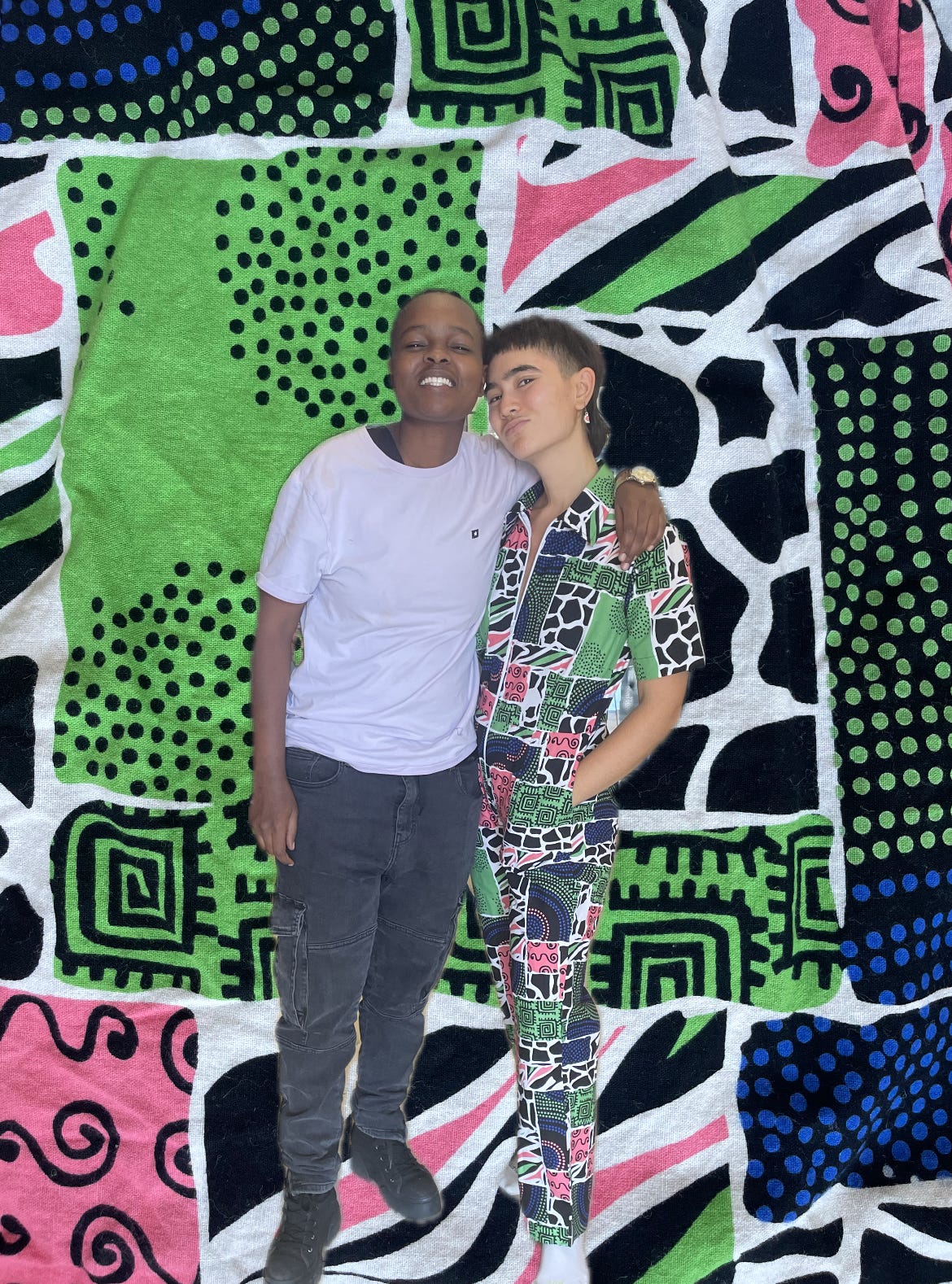
For the 4th edition of The Mental Chit Chat, I am honored to interview Duke Dyke, activist, entrepreneur, fashion designer extraordinaire! We first met at the United Nations Headquarters in New York, where we were both there advocating for LGBTQIA+ rights. Unsurprisingly, the UN is an environment where you rarely see queer, trans, non-binary people of colour in those hallowed halls. It is precisely for that reason that you can often find Duke Dyke and myself in such spaces, speaking truth to power and disrupting the greyscale status quo of the UN in our colorful, joyful, androgenous outfits, handmade by the extremely talented Duke Dyke themselves!
When I first started my career, almost by osmosis, I had absorbed the idea that ‘professional work attire’ meant some kind of boring blouse and basic trousers and or skirt and that was it, and that to wear bright colours or fun patterns was therefore assumed to be inappropriate, unprofessional or immature. How wrong I was, and how actually, fashion, from the streets to the UN, is so deeply personal, a form of gender expression and gender euphoria, and a way to honour your culture. Not least, that whenever I wear my bright orange, yellow and red thrifted jacket, or my patterned jumpsuit (in the cover photo & at @The_Mental_Zine on IG) or rocking a pink mullet (I can almost guarantee I was the only person with pink mullet at the UN General Assembly), people stop me in the corridors to ask me where I bought it, remember me in a future meeting, or even select me first in a Q&A environment because they can see me coming from a mile away! So if anything, it actually helps rather than hinders me in my career!
No one knows this better than Duke Dyke themselves! If you know me personally and/or parasocially, almost any compliment I get on my outfits belongs directly to them. My light green 3-piece gay-ass pinstripe suit? Duke Dyke. My sky-blue suit with the cute little heart buttons? Also Duke Dyke. My wide-leg dark denim pants and matching bomber jacket? Still Duke Dyke. I was therefore so keen to ask them about how their experience as a fashion designer and entrepreneur has supported their mental health in so many ways.
So without further ado, join us as we discuss queerness, fashion, and resistance!
-
Ly: Thank you so much for joining me all the way from Nairobi! I would love to begin by asking you what your experience is with mental health and mental illness?
Duke Dyke: Growing up in Kamba land, Kenya, we were told that having mental illness is a witchcraft and that any conversation around it would be avoided so that you don’t seem possessed. But once I was done with high school and interacted with different people and groups I realized that it was okay to talk about mental health and illness.
Ly: Can you tell me about how this relates to mental health stigma?
Duke Dyke: In my community, which is a deeply rural area and part of my tribe, mental illness is often misunderstood and mischaracterized as witchcraft. This perception is deeply rooted in the combination of limited access to education, lack of mental health awareness, and longstanding traditional beliefs.
This stigma isolates individuals who are struggling, prevents them from accessing the help they need, and can sometimes lead to inhumane treatment. Families might hide them away out of shame or fear or take extreme measures in an attempt to “cure” what is actually a treatable mental health condition.
Many people in the area still worship in shrines and rely heavily on spiritual interpretations of illness and suffering. So when someone begins to show signs of mental health challenges whether it’s depression, anxiety, schizophrenia, or any other condition, it is not uncommon for the community to interpret this as a result of bewitchment or spiritual attack. The person is often taken to traditional healers instead of being supported with medical or psychological care.
The rural area I come from the conversation around mental health is a norm and have a lot of stigma around it, I lost a very close relative who was diagnosed with mental illness but my family members and community think it witchcraft, and they have refused to visit any therapist or medical facilities. The stigma has affected me in a way I don’t trust people that easily and that I still shy away from mental check in conversations.
On top of that, my family don’t know I’m queer because of the intergenerational gap and lack of education in the community where I’m from. They just know I’m a tomboy.
Ly: As an activist yourself, how does your mental health interact with burnout?
Duke Dyke: The activist burnout is real especially given that my kind of advocacy is service delivery through my organization Nadharia, which is a youth community organization and shelter for LGBTQIA+ folk in Kenya that uses arts, partnerships, education, tech and sports to ignite positive social change. It involves physical and a huge part of emotional work. I deal with cases of violence, homelessness which requires you to be in a certain mental space to serve your community year after year.
Ly: That’s incredible. Given you work with young queer folk and are involved in youth advocacy more broadly, what is something you would tell your younger self about mental health and mental illness?
Duke Dyke: That it’s okay to say no and that I can’t save everyone, that talking to a therapist is normal and that it actually works. I would tell myself that this will be different this time, because I have the lived experience, and have experience of how it has affected my life as a young entrepreneur, artist, leader, lover, friend, and community member. If it happened again, I wouldn’t go hide in my cage or take drugs as a coping mechanism.
Ly: What has helped you on your mental health journey?
Duke Dyke: For me personally, creativity, especially through entrepreneurship and fashion design. They have been a powerful tool for protecting my mental well-being. Designing clothes is not just about fabric and thread; it’s about expression, identity, and storytelling. When I create unique pieces and my clients love them, it boosts my confidence. It reminds me that I have something valuable to offer that I can create, contribute, and even sustain myself financially through my craft. That brings me contentment and joy.
Designing has also helped me learn how to connect with people. When I meet clients, I’ve had to learn how to listen, how to communicate, how to interpret what they’re really asking for and that growth has spilled over into other parts of my life. It’s healing, in a way.
That said, it’s not always easy. There are seasons of burnout, or when business is low and money is tight and that can really affect my mental state. But I’ve started learning to trust the process. To pivot when I need to. To believe that the same creativity that got me here will open new paths again.
Ly: That’s so beautiful. I have several tailored suits from you, and one of my happiest memories together is going fabric shopping with you in the markets in Nairobi, and then coming to your brand new shop the following week and trying on all the incredible clothes you’d made in from scratch! You’re so talented!
Can you share a little bit more about your fashion label, and why you started it?
Duke Dyke: I started my fashion label Belowcloud97 as a way to reclaim space, visibility, and self-expression for people like me. Through fashion shows and collections, Belowcloud97 celebrates gender diversity and challenges the rigid norms around clothing in Kenya. The name comes from the day I was born - below the clouds - and the year 1997. It carries both a poetic truth and a sense of grounding. As a non-binary person, I’ve long struggled to find tailors who understand my body, my style, and the fluidity of my gender. Belowcloud97 is my way of bridging that gap—not just for myself, but for my community.
Belowcloud97 centers gender-neutral fashion and embraces sexual and gender diversity with every stitch. The runway has been powerful not just for showcasing designs, but for creating visibility and joy for queer bodies and identities that are often erased. I’m also passionate about sustainable fashion: I work with upcycled materials, and I design everything from bespoke pieces to urban sartorial looks. At its core, Belowcloud97 is about freedom, creativity, and affirming that our bodies and identities are worthy of style, beauty, and recognition.
Ly: I know you use different alias’ for different projects and life phases – I do the same thing! Can you tell me a bit more about this?
Duke Dyke: I think every phase of my life requires a version of me, and names attached to the space or what I am involved in has a different meaning. I used Cameron Drake because I was a drag king performer, Alexis because of football, Duke because I’m fashion killa, Alpha my final name search because of the power and boss vibe I give, and Androgenius because I’m androgynous but also my mind works in such a way that my friends often ask if they can rent my mind for 1 hour.
Ly: I know you recently became a (pet) parent - congrats! Can you tell me how your puppy has helped you on your journey/changed your life?!
Duke Dyke: No matter how tough my day has been or how stressed I feel, coming home to my dog Duke calms me. They make me laugh, keep me active, and remind me to slow down and be present. Just watching Duke be silly or cuddle next to me instantly lifts my mood. In many ways, Duke has taught me about patience, responsibility, and softness all of which support my mental well-being in a deep and personal way. Duke is non-binary, like me, because my dog can’t choose what pronouns to use, and since Duke can’t tell me if they’re male or female, as the daddy I decided that we share pronouns.
Ly: Omg, you are truly the best (gender-netural!) parent ever. An inspiration. Thank you so much for sharing and for being so vulnerable with The Mental.
For all those reading – do yourself a favour and be sure to check out Duke Dyke’s fashion label Belowcloud97 (be sure to dm them for your new custom fit!!), and their community work at Nadharia.
💌
For more, please don’t forget to subscribe and follow @The_Mental_Zine on IG!
Please note that The Mental does not replace any form of professional healthcare, but simple hosts conversations to destigmatise the topic of mental health & mental illness. If you are struggling right now, please know that you are not alone. Please seek support from a medical professional.
If your situation is urgent (and keep in mind, you do not have to be at the rockiest of bottoms to seek help!), please find below a (non-comprehensive) list of suicide and mental health helplines from countries around the world - if your country is not listed, you can google search to find one in your area. These helplines are intended to provide critical, immediate assistance for anyone who may be struggling or needs someone to talk to. If you or someone you know needs help, don't hesitate to reach out to one of these services for confidential support. If you have more to add, please add a comment to this article and we will update this list.
Global Crisis Text Line:
Crisis Text Line (Global, including the US, UK, Canada, etc.): Text HOME to 741741 (24/7, free and confidential support)
United States:
National Suicide Prevention Lifeline: 988 (24/7, free and confidential support)
Crisis Text Line: Text HOME to 741741 (24/7, free and confidential text support)
United Kingdom:
Samaritans: 116 123 (24/7, free and confidential support)
Text SHOUT: Text SHOUT to 85258 (24/7, free and confidential support)
Australia:
Lifeline Australia: 13 11 14 (24/7, free and confidential support)
Beyond Blue: 1300 22 4636 (24/7, mental health support)
Canada:
Crisis Services Canada: 1-833-456-4566 (24/7, free and confidential support)
Kids Help Phone: 1-800-668-6868 (24/7, confidential support for young people)
India:
Snehi: 91-22-2772 6771 / 91-22-2772 6773 (10:00 AM - 10:00 PM IST, emotional support)
Vandrevala Foundation: 9152987821 (24/7, mental health support)
New Zealand:
Lifeline New Zealand: 0800 543 354 (24/7, confidential support)
Youthline: 0800 376 633 (Available for young people 24/7)
South Africa:
Suicide Crisis Helpline: 0800 567 567 (24/7, confidential support)
Lifeline South Africa: 011 242 1911 (9 AM - 9 PM, emotional support)
Germany:
Telefonseelsorge (German Suicide Prevention): 0800 111 0111 or 0800 111 0222 (24/7, confidential support)
France:
Samaritans (SOS Suicide): 01 45 39 40 00 (24/7, confidential support)
Brazil:
CVV - Centro de Valorização da Vida: 188 (24/7, confidential support)
Mexico:
Línea Nacional contra el Suicidio: 800-911-2000 (24/7, free and confidential support)
Japan:
TELL Lifeline: 03-5774-0992 (9:00 AM - 11:00 PM JST, English-speaking service)
Argentina:
Línea Nacional de Prevención del Suicidio: 135 (24/7, confidential support)
Spain:
Teléfono contra el suicidio: 717 003 717 (24/7, confidential support)
Singapore:
Samaritans of Singapore (SOS): 1800-221-4444 (24/7, confidential support)
Pakistan:
AAS: 021-111-22-22-57 (10:00 AM - 10:00 PM PST, emotional support)